Riley Whitelum and Elayna Carausu, YouTube stars with their two children Lenny and Darwin, are leaving their Outremer home to pursue their adventures aboard a Rapido 60. With 1.76 million subscribers on their channel, it’s an understatement to say that this is a huge publicity coup for the manufacturer, that has been somewhat lacking in terms of communication until now. It’s also an opportunity to (re) discover this specialist that works in a very specific niche, that of large folding or dismantlable trimarans.
The Rapido Trimarans team of Paul Koch and Richard Eyre, founders of the shipyard, has several decades of experience in the construction of various types of multihulls, including subcontracting. Their primary aim is to produce light and modular craft - folding floats and using carbon construction - which contributes to the creation of a successful concept. Without forgetting, of course, the performance and stability of a successful trimaran. “The whole Rapido trimaran concept came about because we felt the world needed a larger, more roomy, cruising trimaran with good living space that delivered great performance,” explained Paul. In fact, the current production of folding trimarans stalls at the 40-foot mark, with the Corsair 37 and the Dragonfly 40.
 |
 |
 |
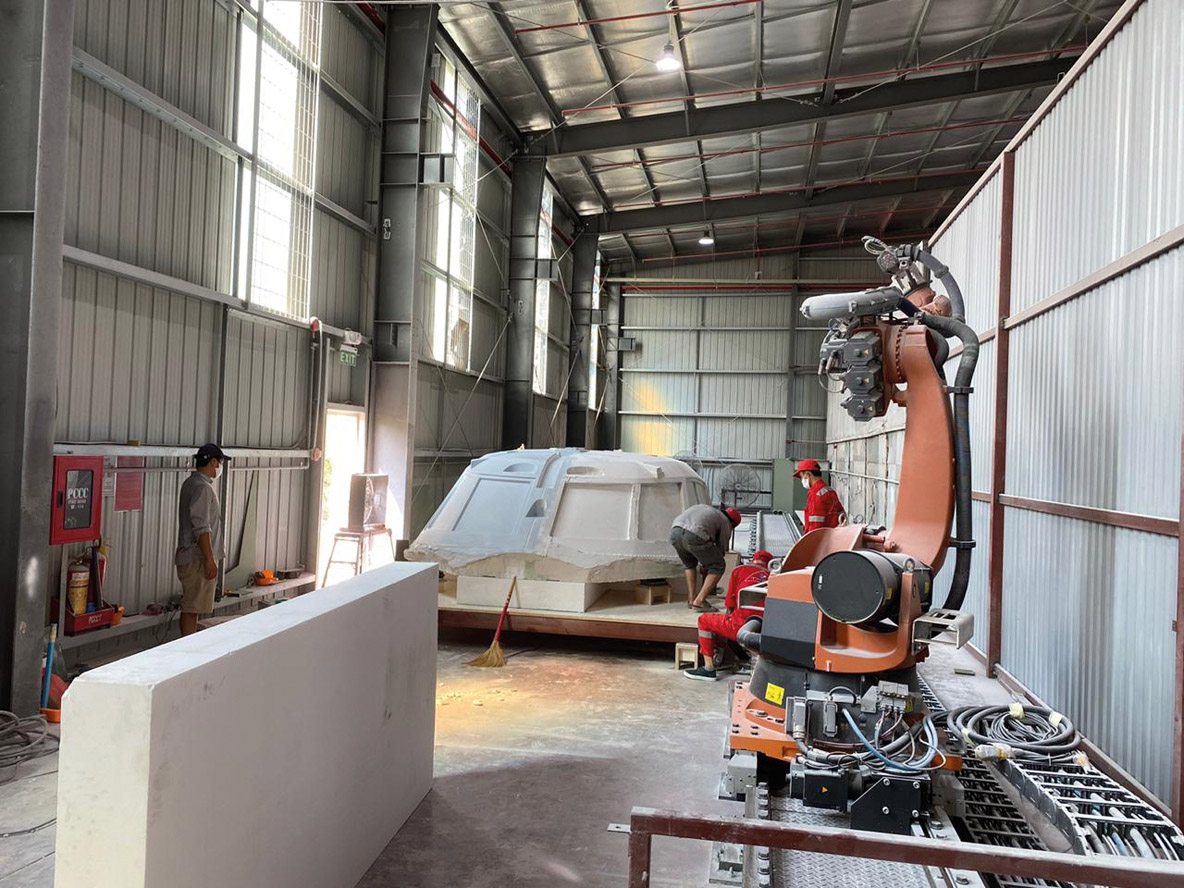
The Triac Composites site in Hoh Chi Minh City is home to an impressive Kuka milling robot.
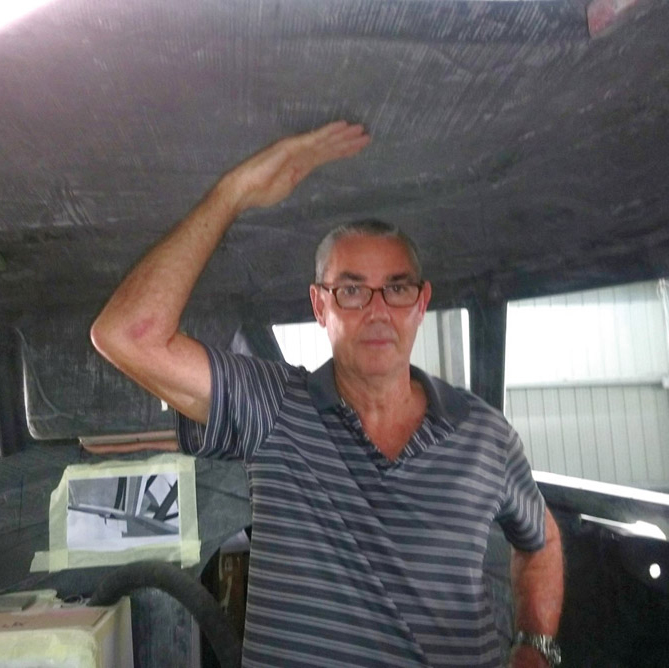
Rapido boss Paul Koch, a very tall Australian, demonstrating the headroom in the new 40.
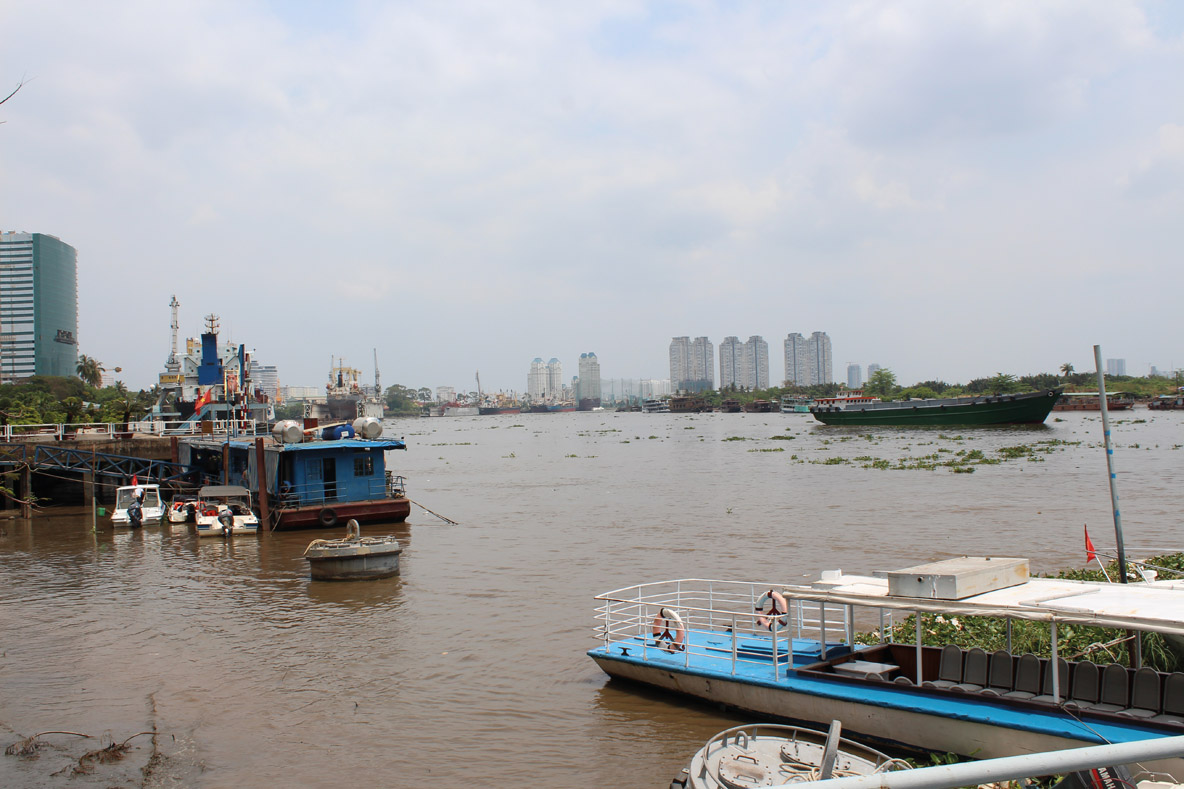
The Soai Rap River is the sea road for trade in Hoh Chi Minh City.
Rapido… the name says it all
Over the years, I’ve watched the steady development of what is one of the few cruiser-racer trimaran designs. Back in 2016 I recall racing against Rapido 60 Hull #01 at the King’s Cup in Thailand and being impressed. During that regatta, the R60 overtook the TP52 fleet on a hard beat clocking 16 knots speed. The four crew were relaxing on the nets while the 16-person crew on the TP52 were on the rail! In another race, an IRC 1 monohull tried to luff the R60 up and failed. So, the pointing abilities of the R60 is right up there with racing monohulls.
When mentioning multihull design, the prolific names of Morelli and Melvin often appears. They applied the latest technology in designing all three Rapido models including their use of computational fluid dynamics, finite element analysis, and velocity prediction programs. “The innovation in design comes with the layout of the main hull and reaching the balance between beam, draught and trim to carry the accommodation without too much compromise on performance,” said Pete Melvin.
 |
|
YouTubers Riley Whitelum and Elayna Carausu out on sea trials on a Rapido 60.
Foldable and dismantlable
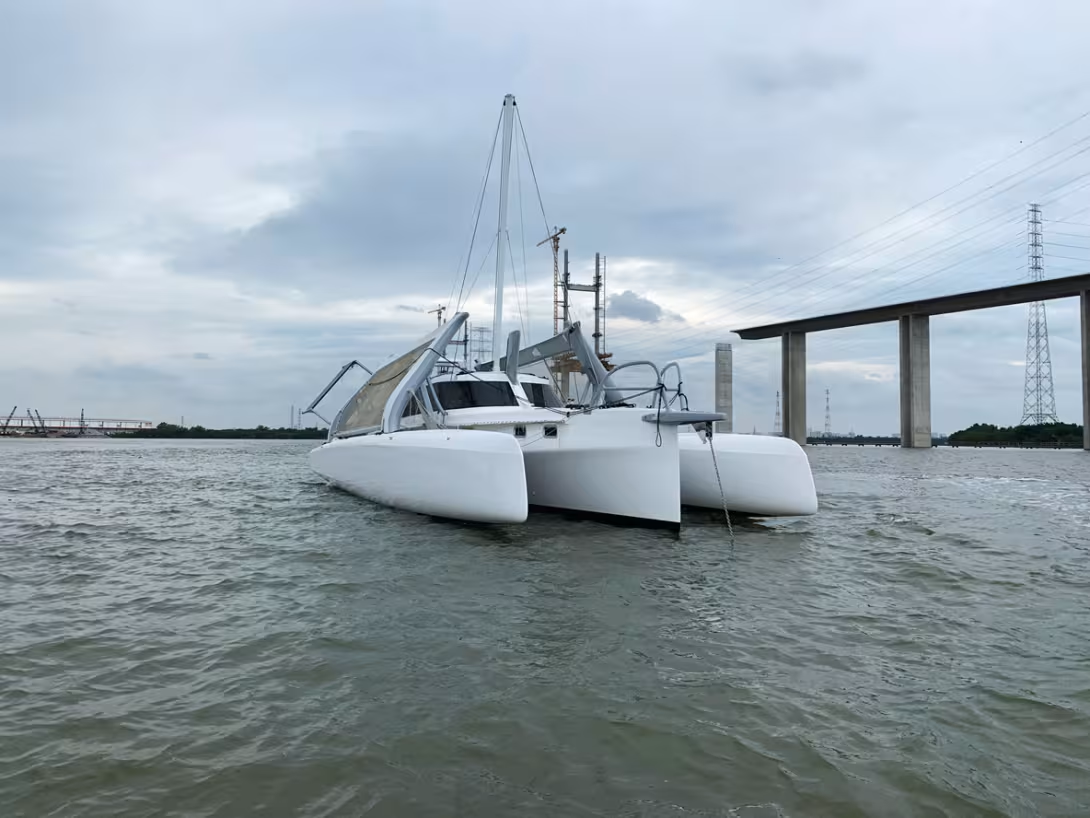
Rapido overcomes the main issue faced by trimarans - berthing - by using folding amas on the 40 and 50. Separately, the Rapido 60 has a unique and innovative design that enables the beams to be readily unplugged for shipping. The folding concept was already proven in Koch’s previous trimaran builds which used the Farrier-designed folding system. Koch was the owner of Corsair Marine, where he was directly involved in the production of 1,500 trimarans, between 1994-2010. An enhanced carbon version of the folding amas has been developed for Rapido. In addition, this patented folding mechanism keeps the amas in the upright position, ensuring that the sides remain free of any unwanted algae growth.
Rapido’s technically advanced manufacturing arm, Triac Composites, builds all three models as well their tooling in its modern factory in Ho Chi Minh City. An exciting, bustling river city that I enjoy visiting because it has a lively multihull yard scene that includes Australian Seawind catamarans and the Corsair yard as well. The Triac yard boasts a list of equipment which includes a seven axis Kuka milling robot, autoclave, a CNC machine, a high-speed digital carbon cloth cutting machine and a dedicated spray booth. It can also do vacuum infusion and resin transfer molding. The first R50 launched in Spain in June 2021, while the R40 splashed early in 2022.
 |
 |
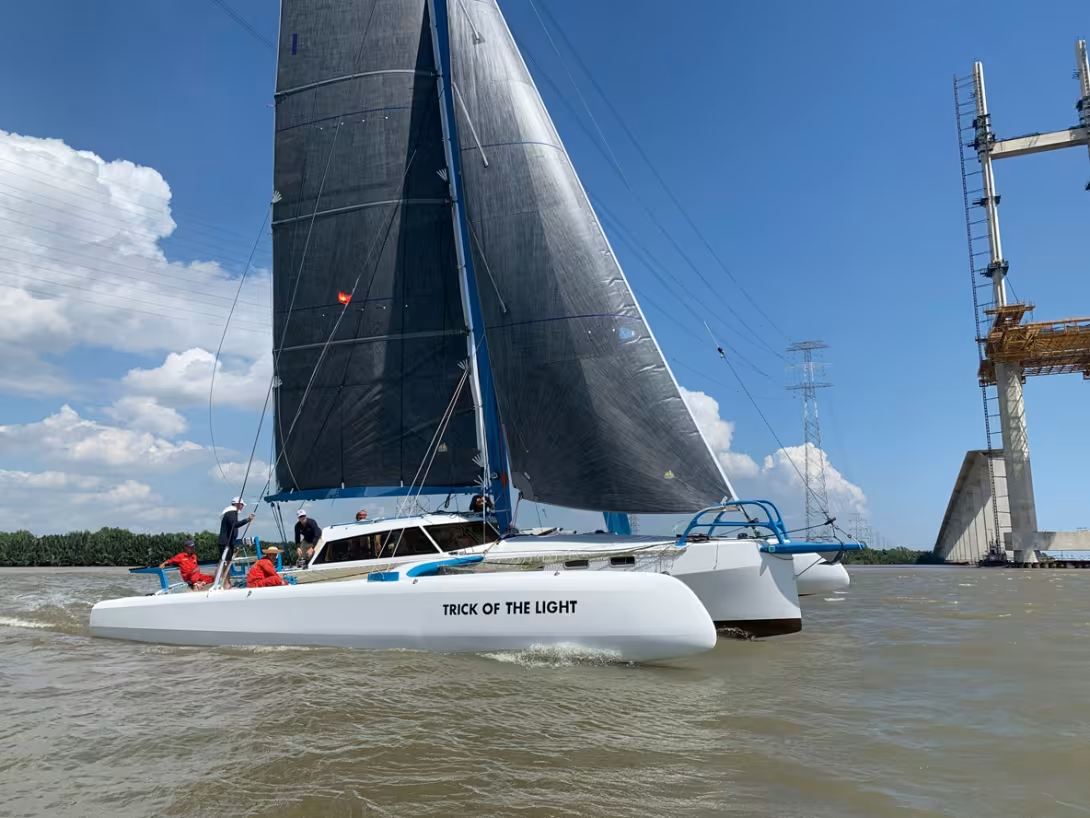
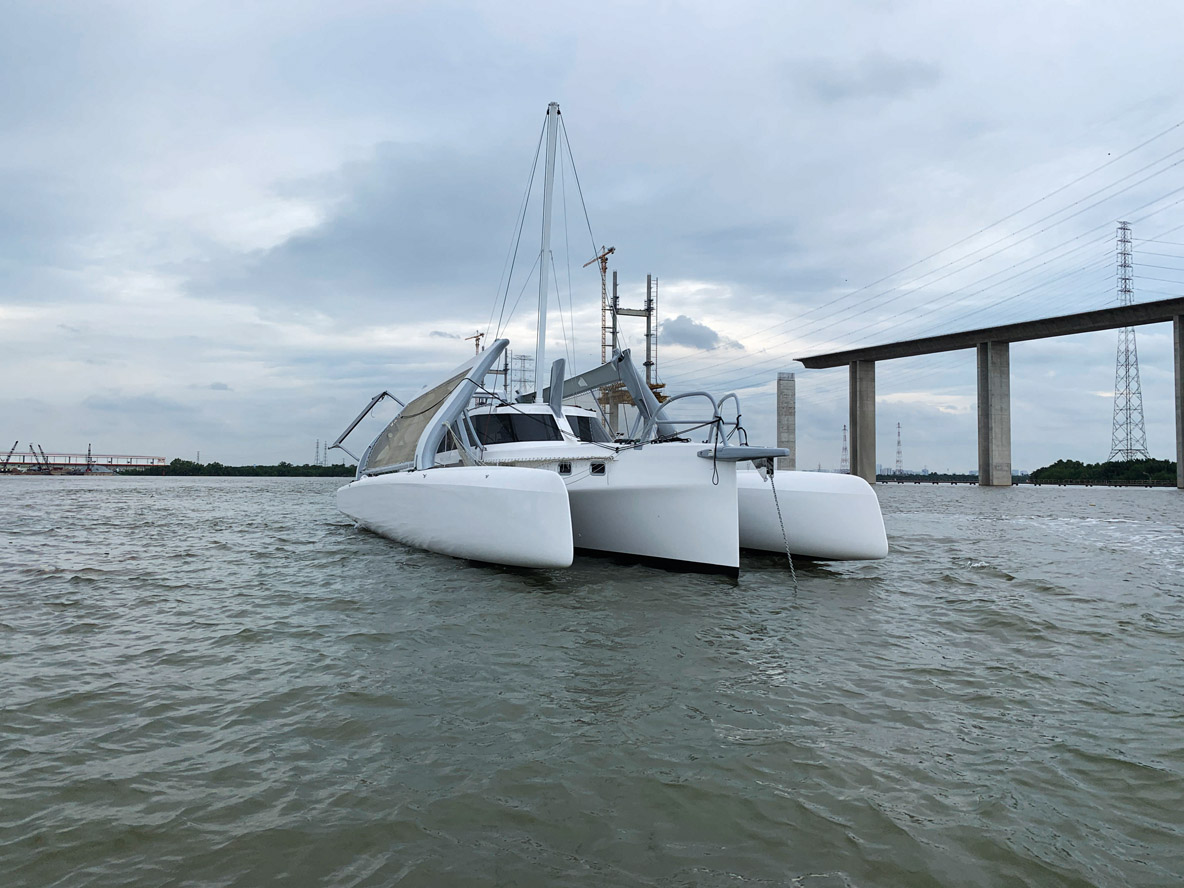
Sea trials in Vietnam of the Rapido 50’s folding amas (with a demonstration mast installed).
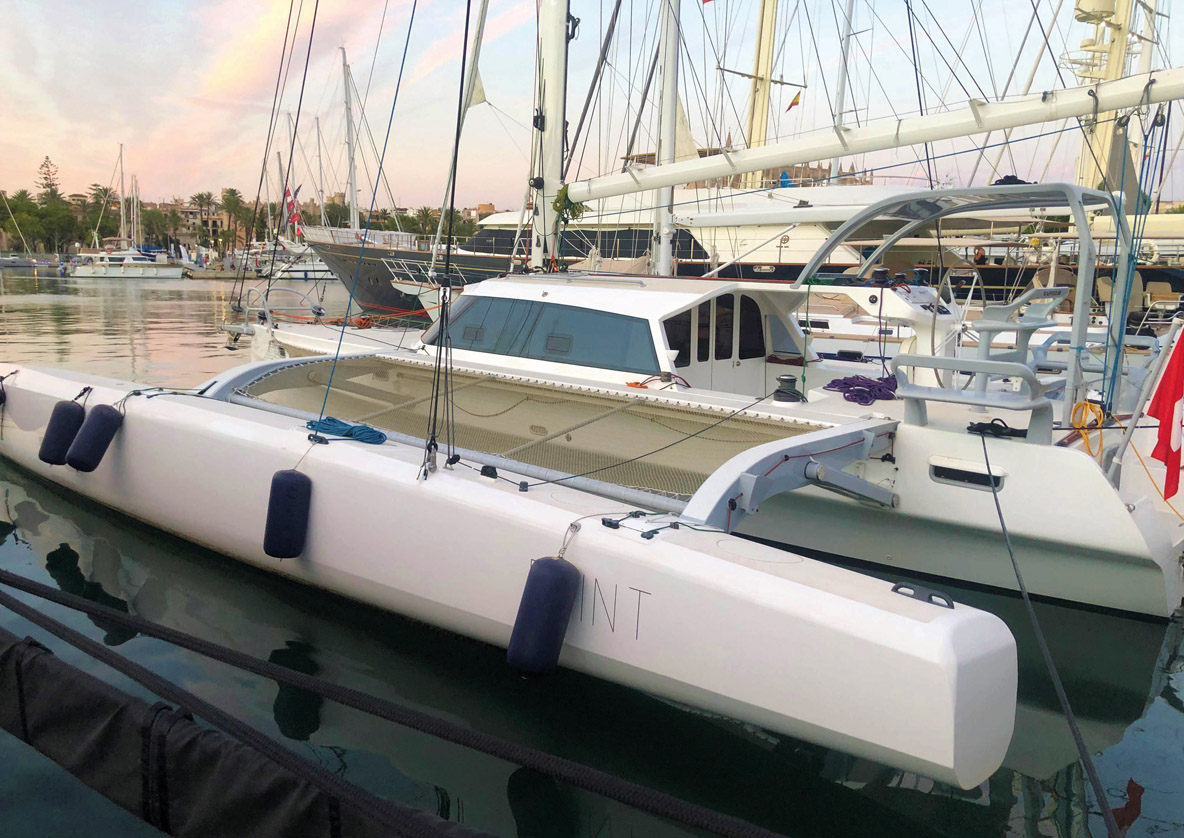
Launching hull number one of the R50 in Spain, June 2021.
Stiff and light hulls
Rapido use infused carbon/vinylester laminates on closedcell PVC cores for high-strength areas and E-glass with carbon elsewhere. Vinylester is used in the hull and deck laminates for good adhesion and better compatibility with the gelcoat finish than with epoxy laminates, which are used in the structural elements of the boat. The build conforms to ISO/CE standards and CE Category A certification. “We use pre-preg carbon for the high-strength parts such as the cross beams (which are cured in the autoclave), chainplates and bulkheads,” says Koch. Key hull features include watertight bulkheads and the extensive use of carbon fiber. Triac Composites’ experienced engineering team and its use of sophisticated technology ensures stringent interpretation of Morrelli and Melvin’s drawings, aided by the trust of Koch’s 30-year association with the designers.
 |
 |
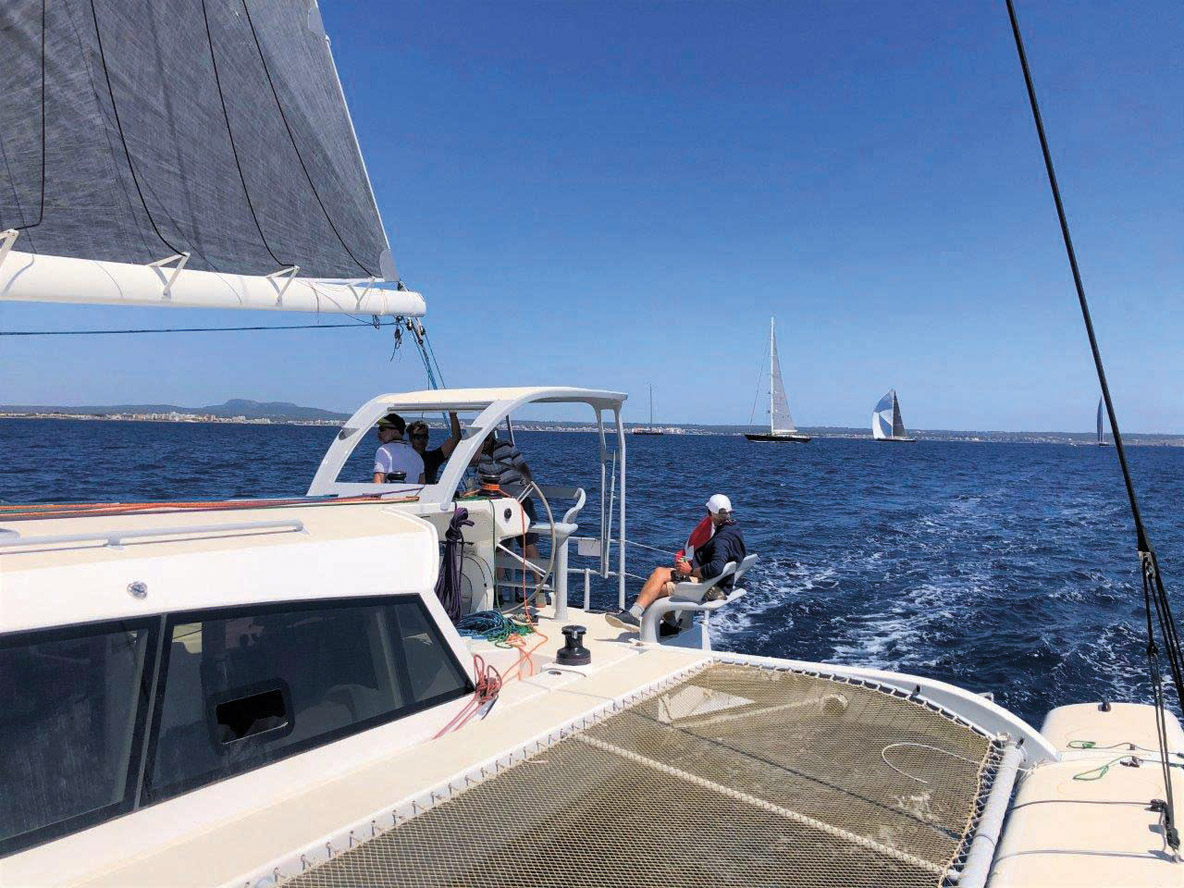
Flint’s first sea trials off Palma de Mallorca in the summer of 2021.
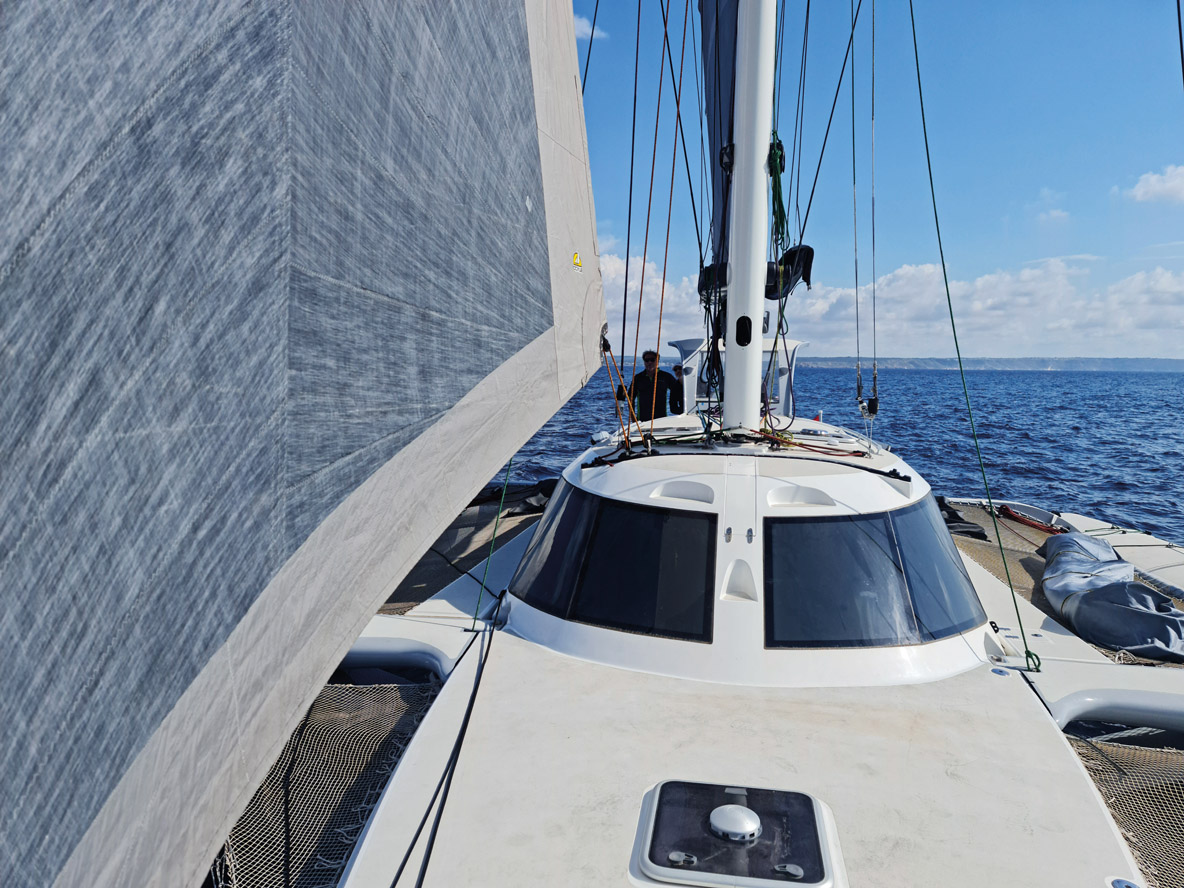
The forward-facing saloon windows are a useful feature in the Rapido 50.
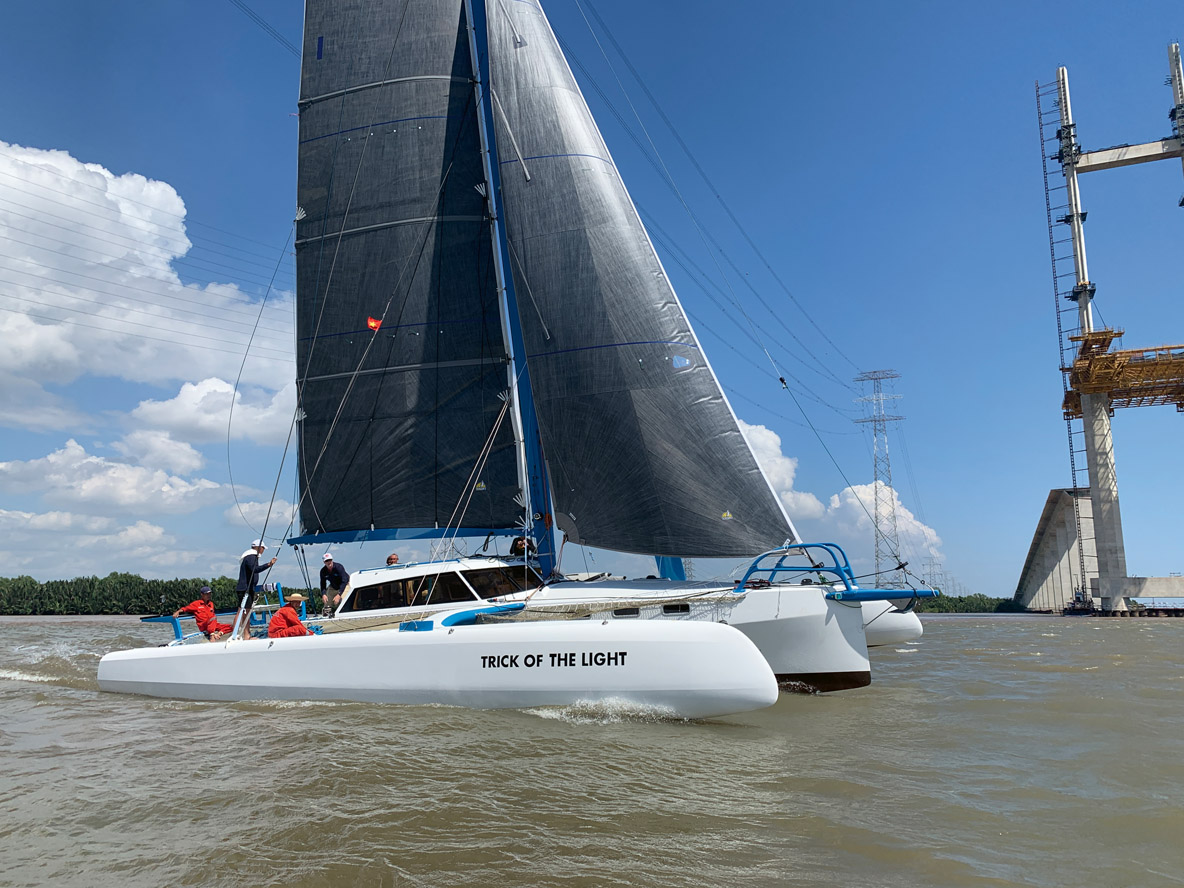
Rapido 40
New for 2022!
 |
 |
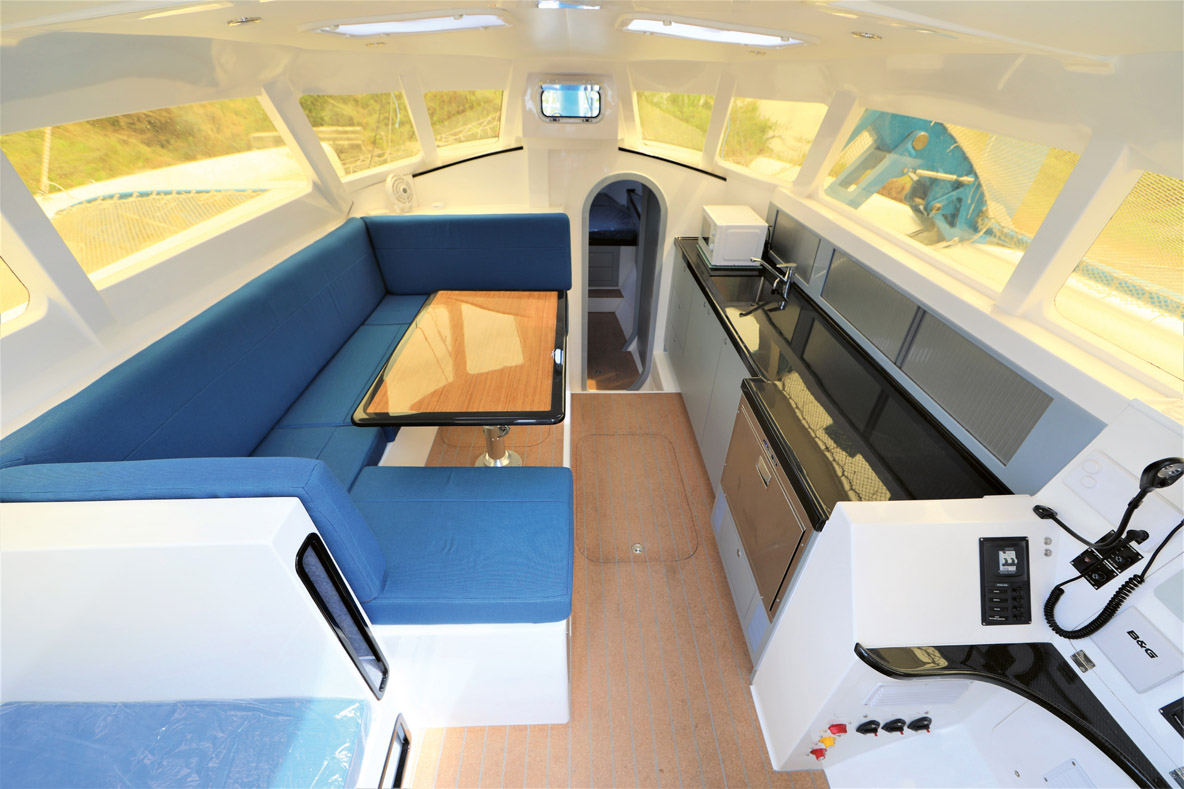 |
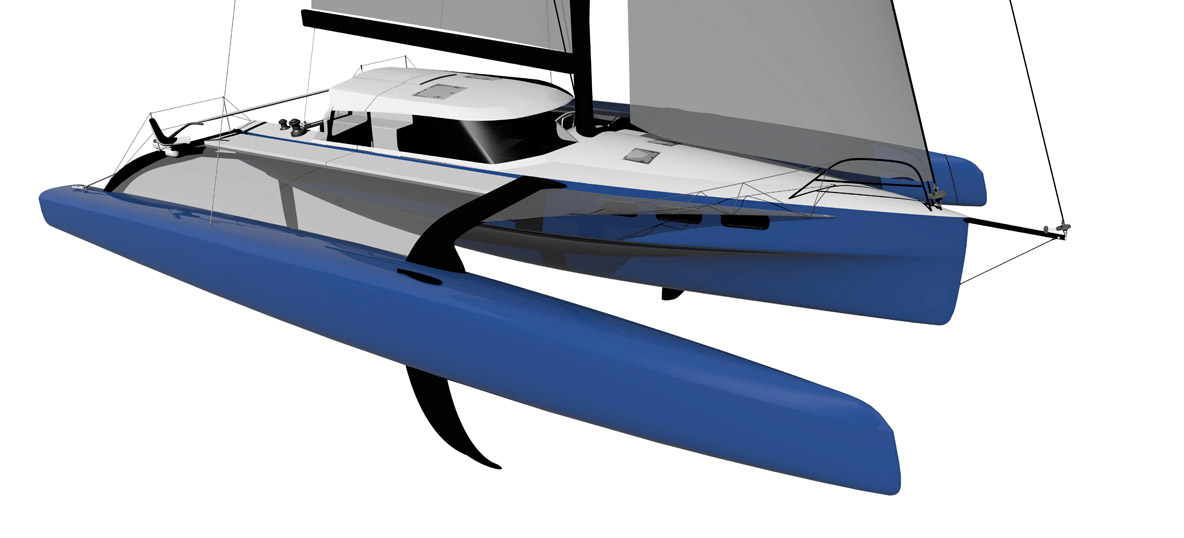
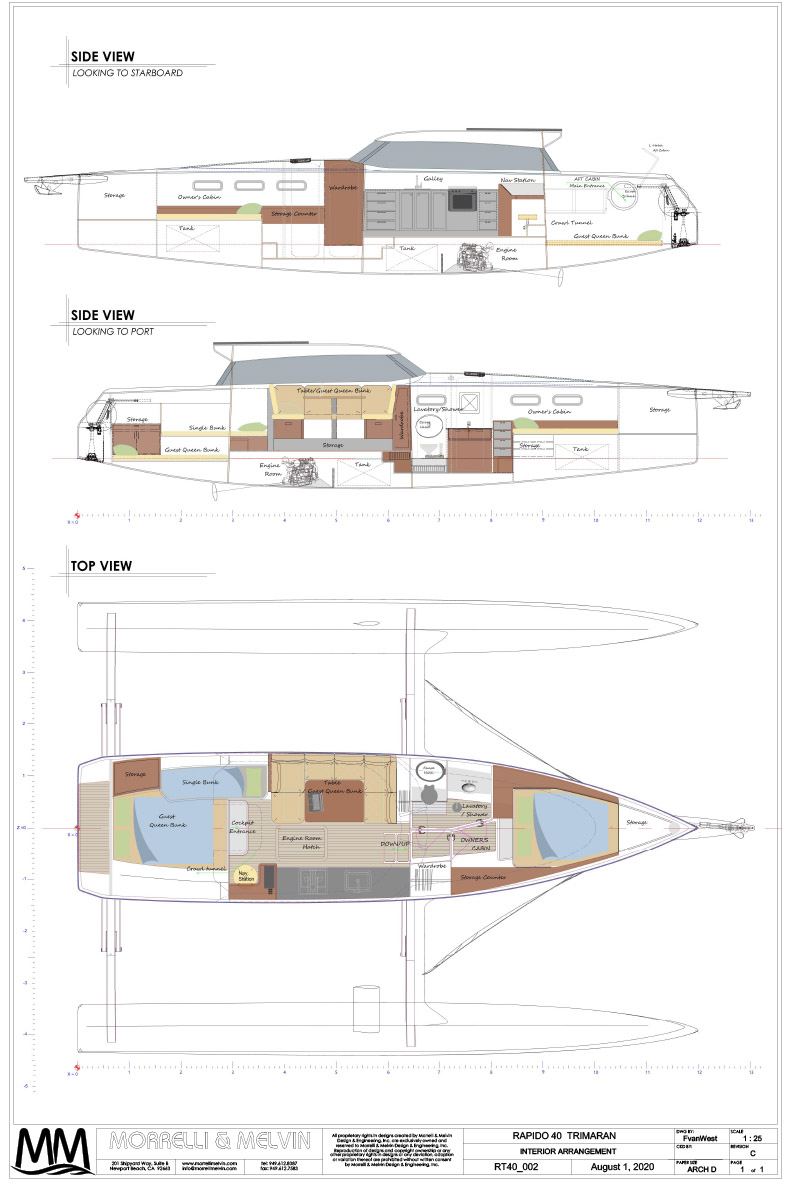
The Rapido 40 is designed and built in carbon to be a performance cruiser; so an ideal boat for doublehanded cruising, or regattas. It comes with two double cabins like its larger siblings but with a very different saloon to them. Missing is the large central bulkhead for the daggerboard, as designer Erik Berzins from Morelli and Melvin explained: “Removing the main hull daggerboard case which also serves as a mast compression post (the configuration on the larger 50 and 60 models) allows the mast to move onto the primary beam bulkhead, a major game-changer to maximize the central hull living space of this smaller performance trimaran. The float boards carry a little more weight and complexity than the central daggerboard system but allow for the best of both worlds: sportsboat performance with substantial interior comfort and living space.”
Achieving this has been done by using ama foils and a T-shaped rudder foil; and aided by the V-shaped hull. “The Rapido 40 has long curved asymmetrical foils in the floats, providing significant side force and vertical lift”. The high lift-to-drag ratio of these asymmetrical boards allows the 40 to sail upwind efficiently, while downwind they reduce the effective displacement of the boat and really let it break free for some exhilarating performance,” says Berzins. The Rapido 40 polars show 30 knot boat speed in 25 knots of wind at 95 degrees.
The Rapido 40 sail plan uses a self-tacking jib, carbon spreader-less mast and has an option for roller furl boom. The interior has lightweight, strong, custom-made furniture including carbon countertops. The flooring finish is cork, for comfort and grip when wet. Safety is a big factor in design and construction. As well as carbon-foam construction, there are watertight bulkheads. The engine compartment is contained within one of these watertight bulkheads.

Builder: Triac Composites, Vietnam
Design: Morrelli et Melvin
Overall length: 39’4” (12 m)
Waterline length: 39’4” (12 m)
Beam: 28’10”/16’1” (8.8/4.9 m)
Displacement: 10,460 lbs (4.7 t)
Freeboard: 4’8” (1.41 m)
Draft: 2’10”/7’2” (0.87/2.18 m)
Mainsail: 700 sq ft (65 m²)
Staysail: 140 sq ft (13 m²)
Reacher: 861 sq ft (80 m²)
Spinnaker: 1,700 sq ft (158 m²)
Wing mast area: 75 sq ft (7 m²)
Max air draft with US ICW mast: 64’2” (19.25 m)
Headroom: 6’7” (2 m) in the saloon; 6’3” (1.9 m) in the fwd cabin
Engine: Yanmar 29 HP Fuel: 52 US gal (200 l)
Water: 52 US gal (200 l) CE Category: A
Price: $ 595,000 ex-factory Vietnam
Optimization of the central hull
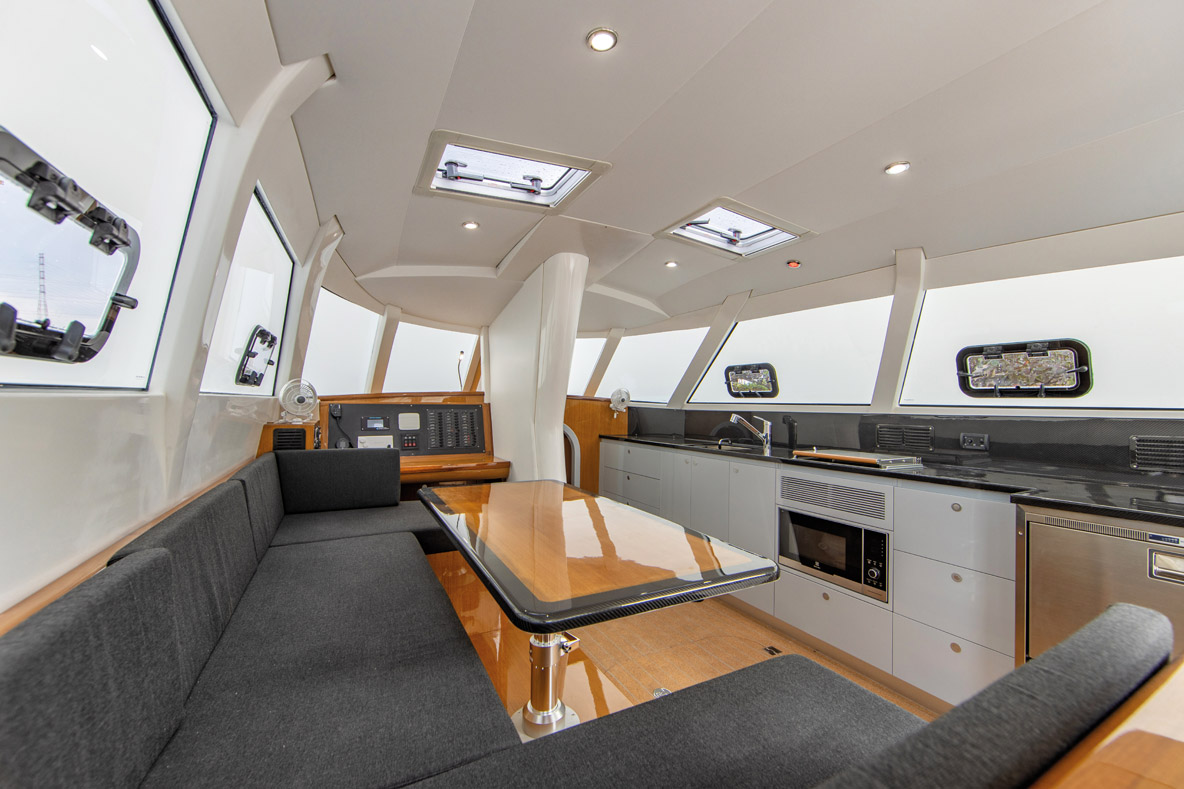
“Traditional” trimarans (note that we can’t include NEEL and their wide nacelles here) have a reputation for lacking living space and carrying capacity. Rapido tackle this problem by maximizing the hull volume and headroom – a fact immediately noticed by the couple from La Vagabonde during their test sail. The center cockpit design with helm above solves several problems – it creates a safe area beside the saloon while the steerer can see clearly. The helm deck has side seating and a wide binnacle seat for two; and all sail controls lead to here. More living space is on the nets between the center hull and a wide foredeck. The center cockpit design means the saloon/ dining/ galley is all on one level, with self-draining. The door to the saloon can swing into the roof when not in use so that the whole area opens into one large space. The daggerboard dominates the saloon on the 50 and 60 but the new 40 has “C” foils in the amas and this removes the need for a daggerboard case in the saloon which further opens up the interior space. This elevated floor plan inside creates the volume required in the bilges for the engine and tankage which centers and lowers weight - just like a monohull (and unlike a catamaran). The aft of the salon can be open or closed, depending on the prevailing weather or sea conditions.
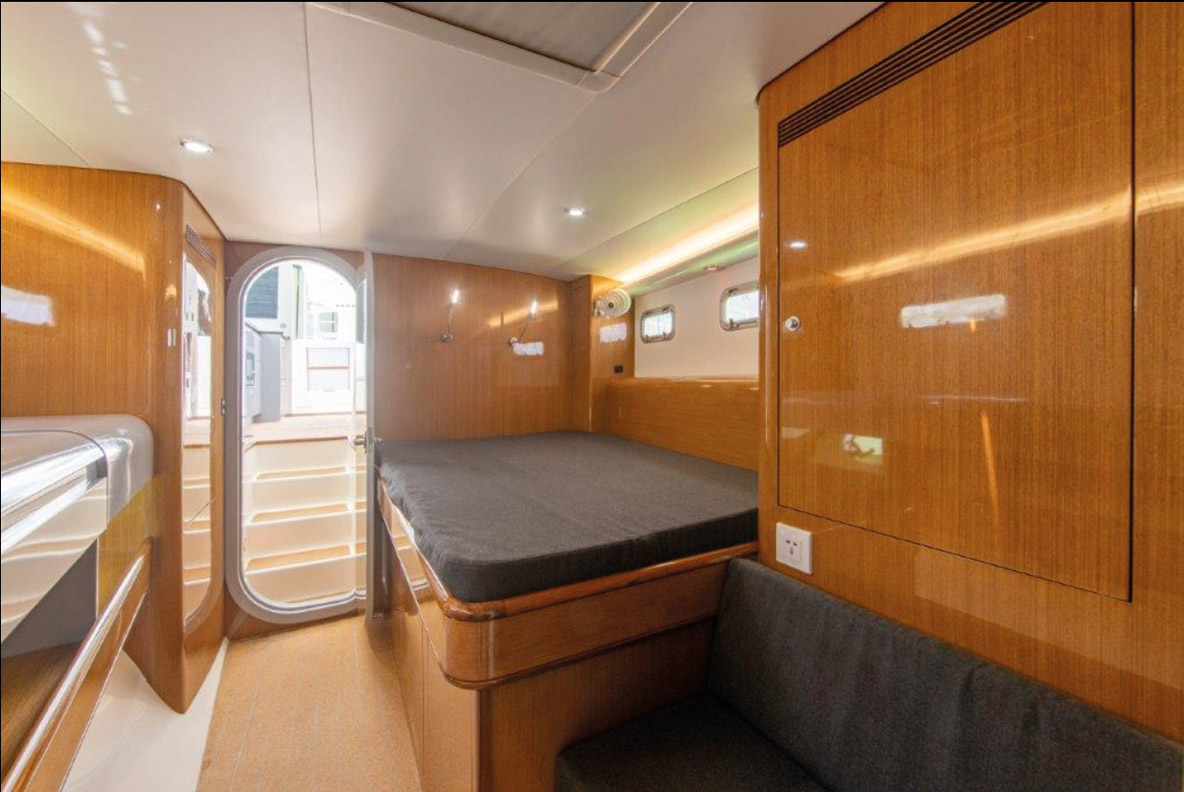
Inside, the forward master cabin is a double with generous storage, thanks to it being deeper in the hull than the saloon. The cabin includes a head with separate shower compartment. An escape hatch is here, along with one in the stern. Alternatively, two single bunks can be added to the forward cabin on the 60. The aft cabin has a large double bed with its own head/bathroom. The saloon has an L-shaped settee and table opposite the longitudinal galley which is well equipped with hob, oven and deep sink.
The 50 has better vision all-round than the 60, thanks to forward facing windows which can be frosted instantly, literally, with the flick of a switch. It also has a navigation station alongside the settee. Headroom inside both the 60 and 50 is two meters (6½ feet) plus. Furnishings, doors and other fixtures are foam cored with veneers for lightness; and are fully integrated into the hull for rigidity. The entire fit-out has rounded surfaces to avoid bruising and easily wipe-clean surfaces.
 |
 |
 |
The saloon is on deck level and dominated by the centerboard.
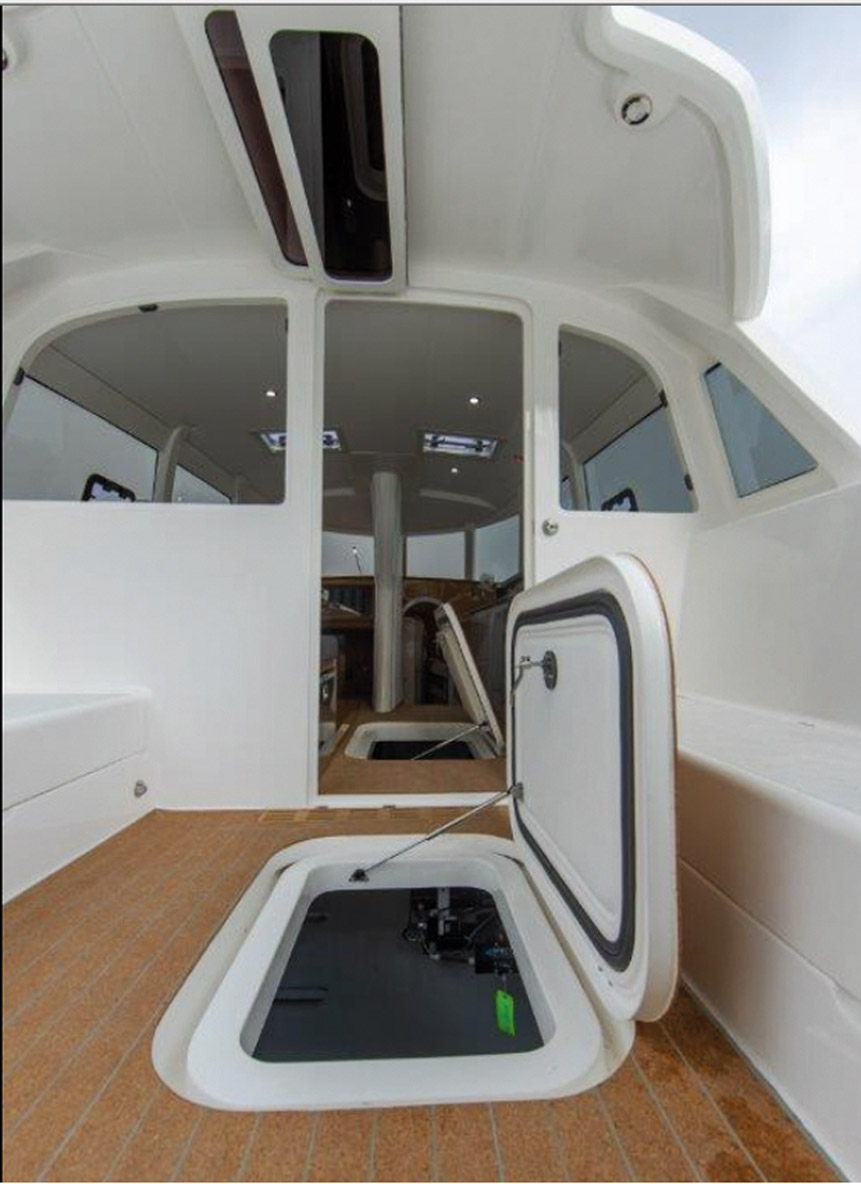
The center cockpit separates the stern cabin from the saloon.
The owner’s cabin on the R50.
Powerful yet controllable rig
All Rapido models feature rotating, carbon masts to maximize performance. The standing rigging is synthetic. An extensive sail plan means there’s a manageable amount of power available both upwind and downwind; an important consideration for safety reasons in a fast boat like this. The furling Solent genoa, mounted on the inner forestay, is selftacking and the mainsail reefing system uses Karver reef hooks mounted on Dyneema straps around the boom to distribute the loads with minimal chafe. The boom has truss wings with netting to catch the full-battened mainsail, which is on Antal sliders for easy hoisting, reefing and furling. A furling fractional Code 0 and a masthead furling gennaker tack on the bow just ahead of the headstay. Two Harken winches on the cabin top forward of the helm station handle main and Solent sheet loads. Rope clutches for halyards, mast rotation and board up and down controls are positioned to use the same winches.
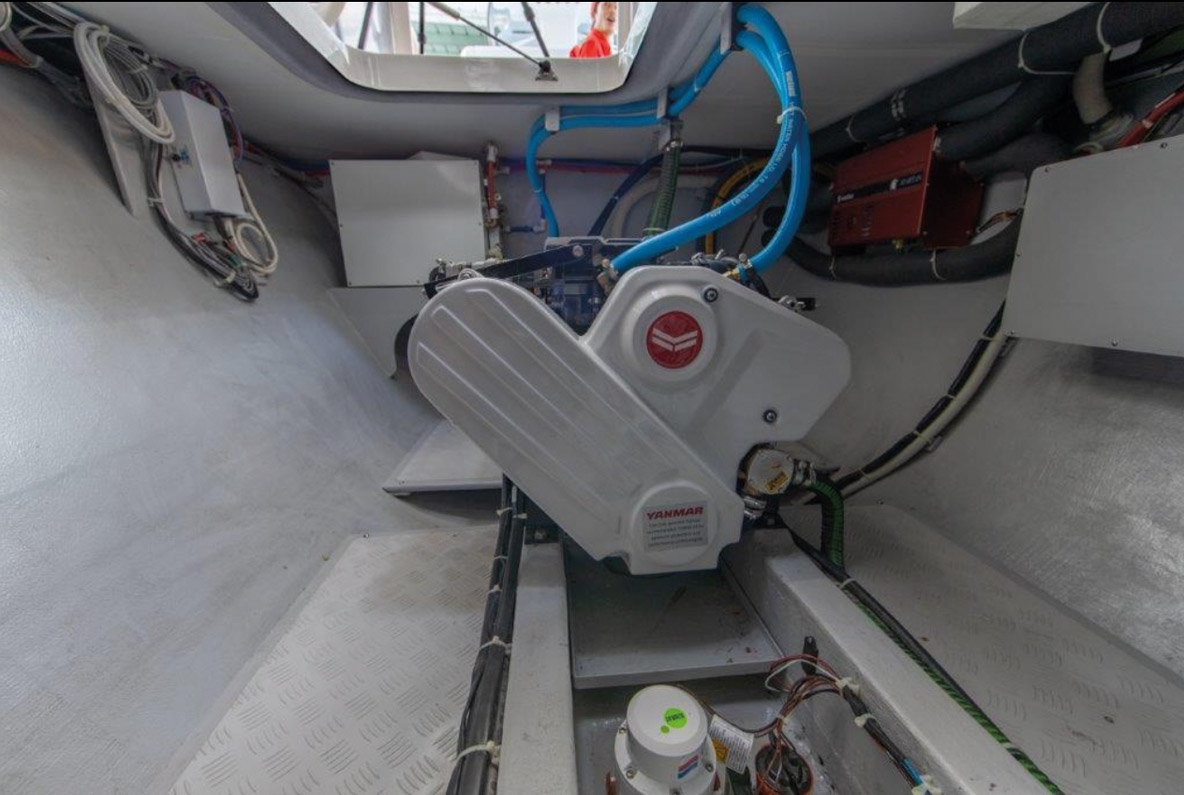
This efficient use of systems, goes right through the design, says Pete Melvin: “Compared with cruising cats, cruising trimarans in general are much simpler for their reliance on only one system for steering and propulsion.” For example, the full-access engine room on the Rapido 60 is next to the daggerboard case at the weight-center of the boat. All parts of the Yanmar 4-cylinder 53 HP diesel are accessible from all sides. This space also includes the fuel tank, an optional 8 kW generator and room for water makers and other options.
 |
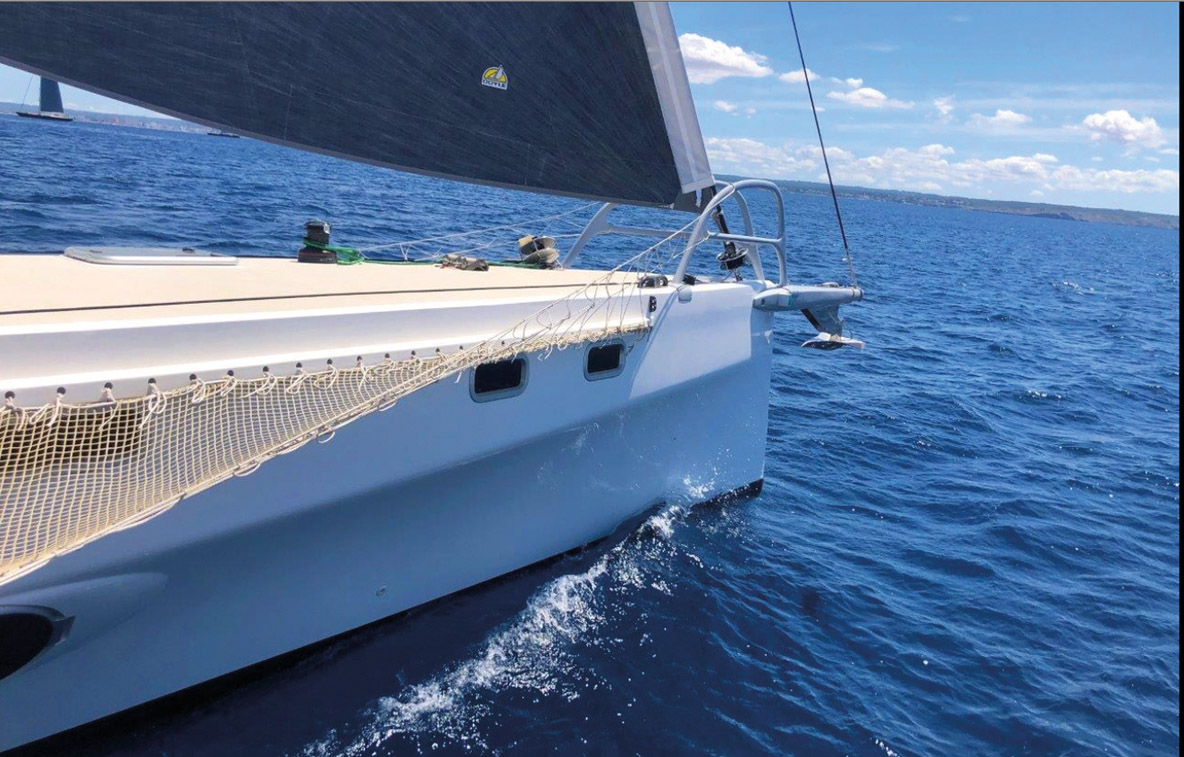 |
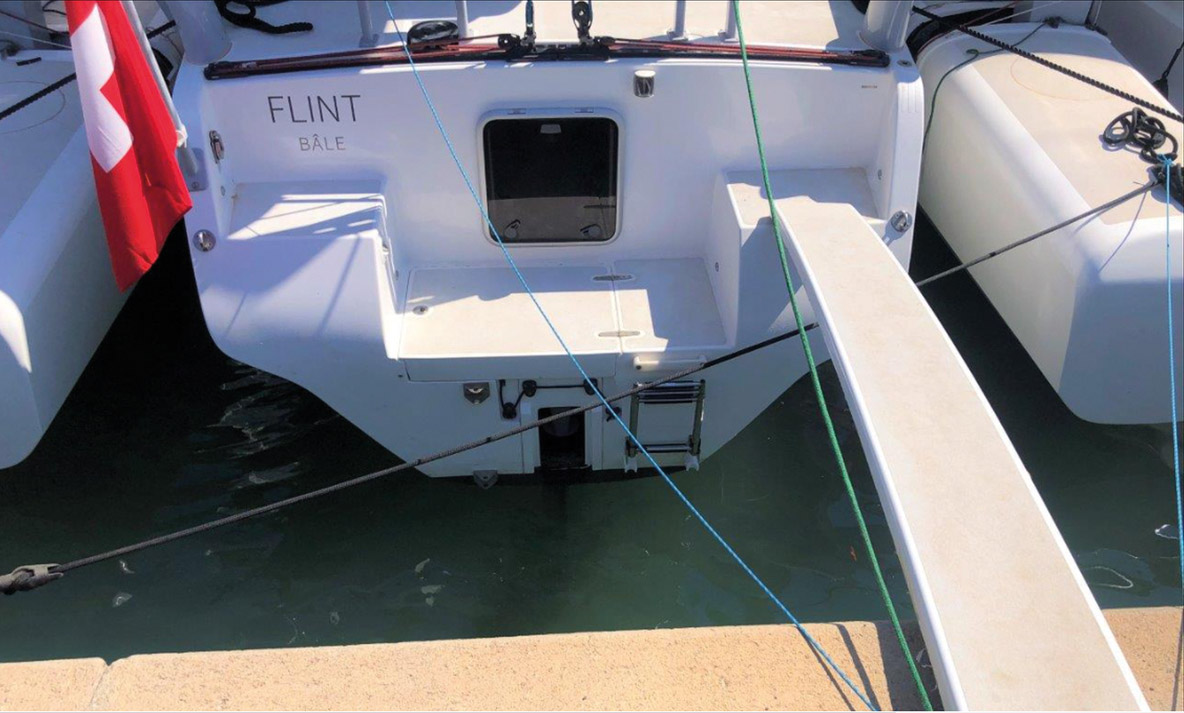
The stern and one of the two escape hatches on the Rapido 50.
The hulls have fine entry but flair topsides to maximize internal volume in the central hull.
Cruise faster!
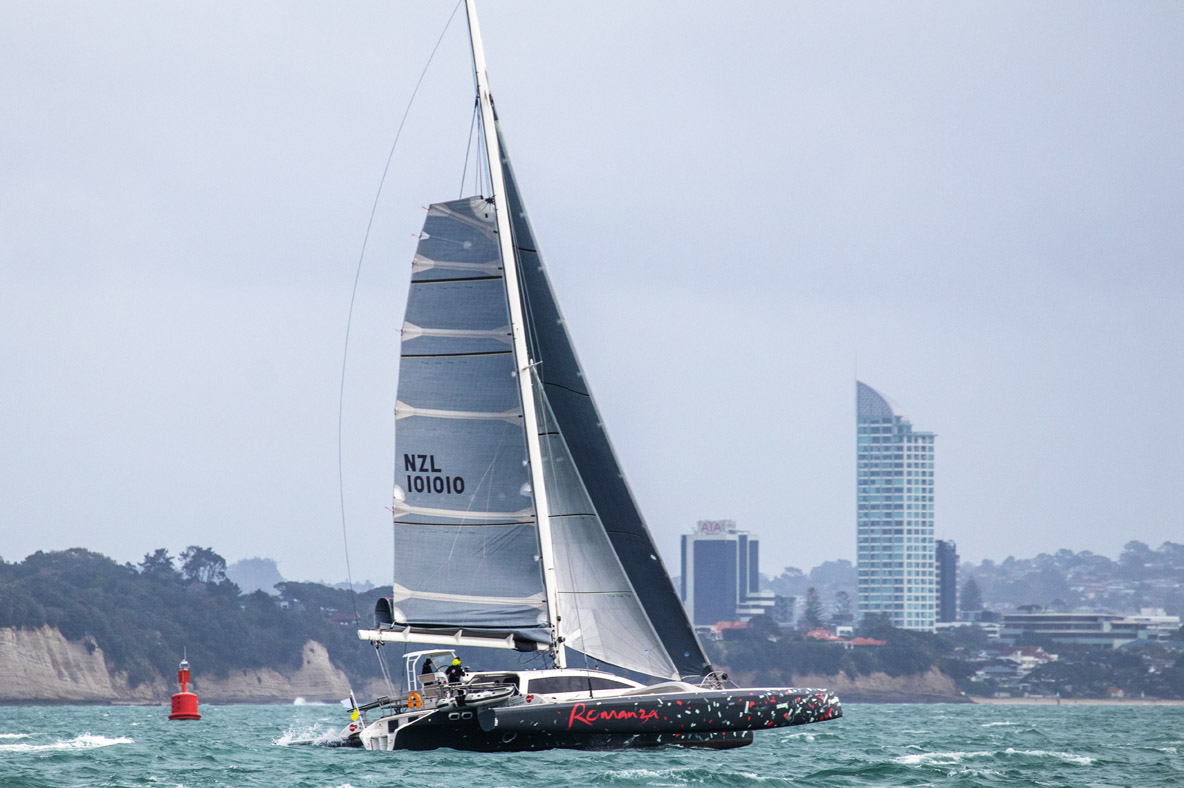
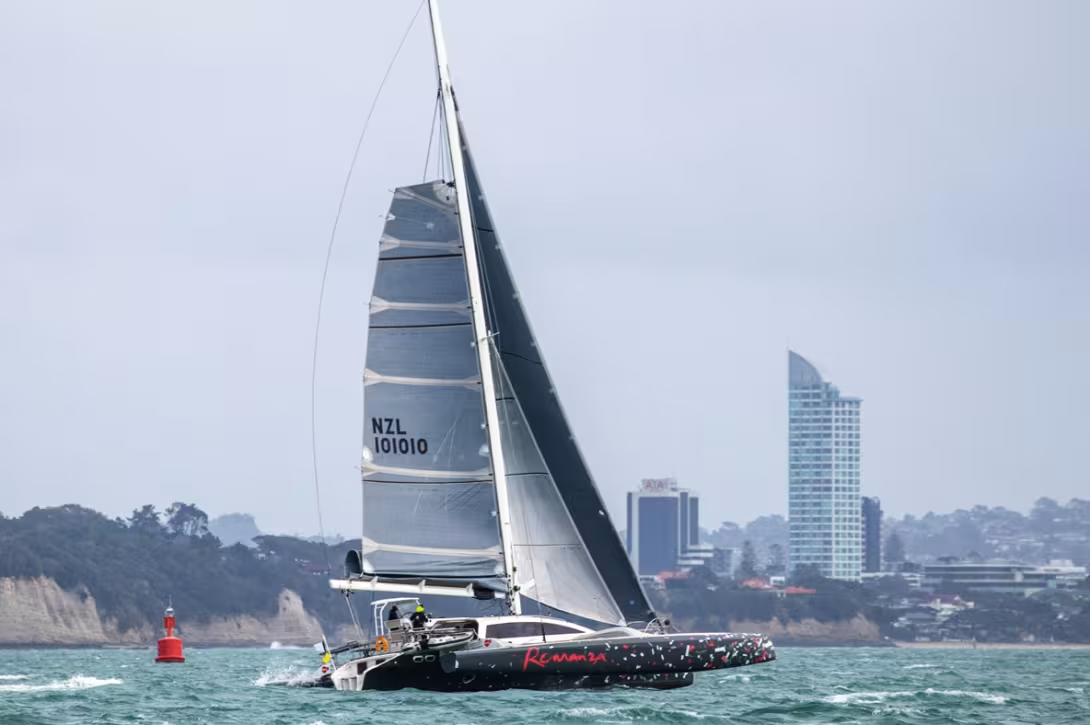
The Rapido 60 was the model that launched the brand in 2015. This is Romanza on her home waters in New Zealand.
Despite the differences between the three models, what they all share is a performance efficiency which rewards the discerning sailor. The launch of its compact 40-footer now increases the competition considerably in this niche arena. The niche aspect I’d say refers to the need for an experienced sailor as these styles of boats have a high powerto- weight ratio and other potentially challenging characteristics for the unwary. The polars for the Rapido 60 show it capable of climbing to a figure of 25 knots in 20 knots of true wind! However, thanks to the meticulous design of Morrelli and Melvin, the boat is actually very forgiving according to owners of the Rapido 60 Romanza who cruise in New Zealand. The massive buoyancy of the amas and righting moment of the Rapido models has been built into the design to make them safe, stable trimarans.
Safety, in fact, is a driving factor in Rapido and the carbon foam sandwich construction combined with several watertight bulkheads in the amas and main hull (even the engine compartment is enclosed with watertight bulkheads fore and aft) is such that the boats are virtually impossible to sink. The inherent stability of a trimaran with its nearly square design and weight centered in the middle creates a monohull-style sailing experience with multihull stability.
 |
 |
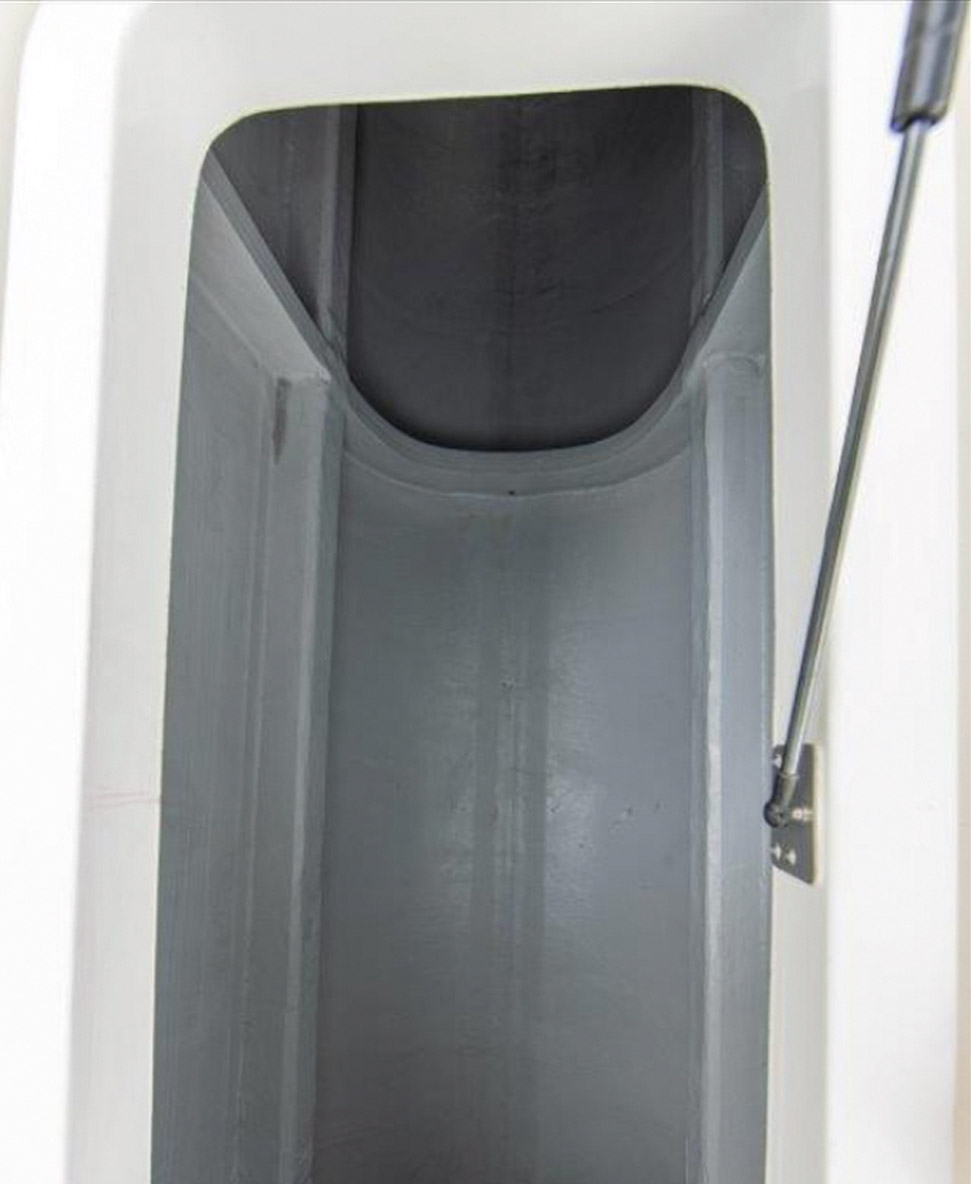
One of Flint’s amas, showing longitudinals and stringers.
The 38.5 HP Yanmar is equipped with a folding propeller.