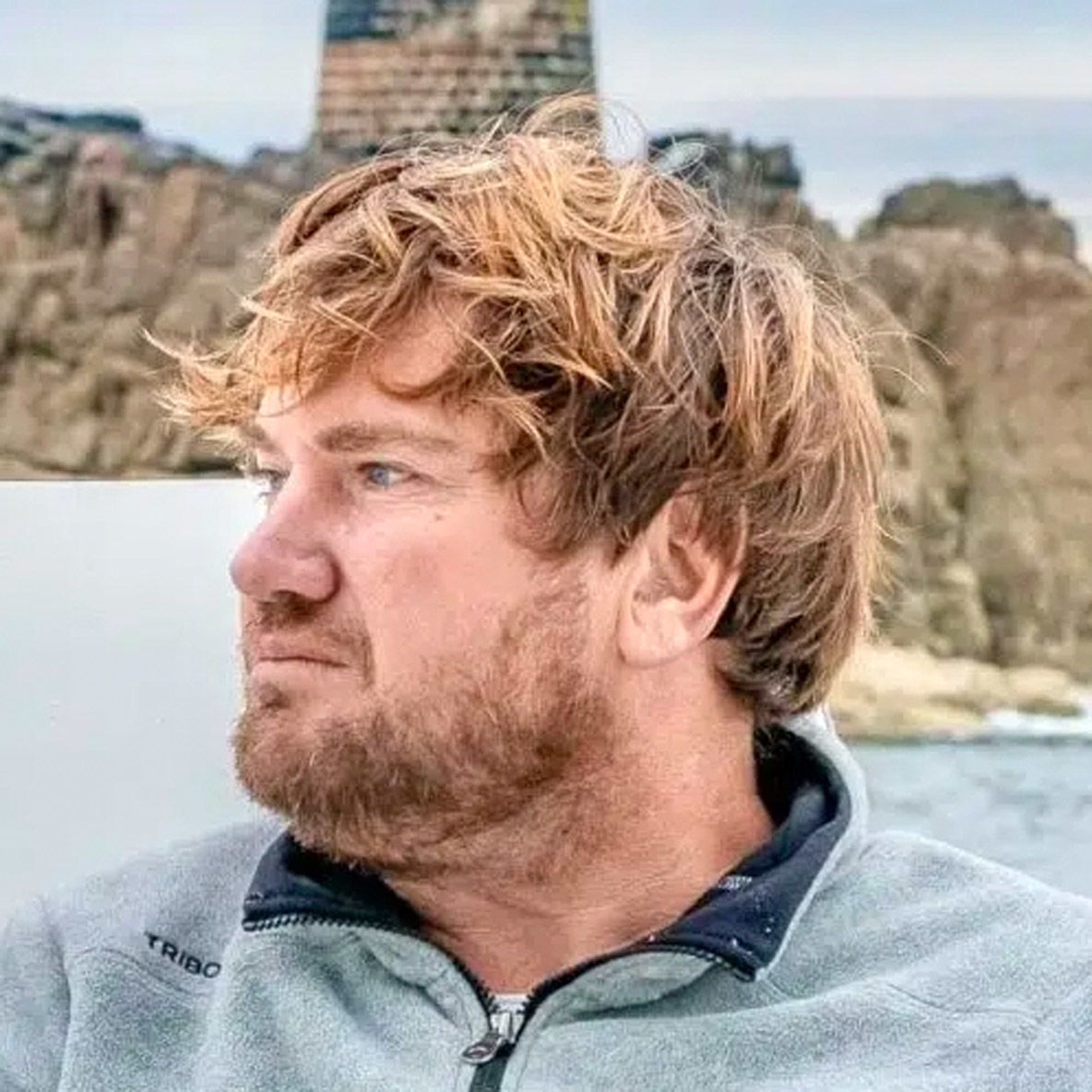

“Hello, Emmanuel, I’ve got good news and bad news...” The barely- awake voice of the Multihulls World editor, on assignment in the south of France making and his way between the fresh water of the inland waterways and the salt water of the sea, responds with a laconic and concerned question: “Brieuc, what have you done now?” While in transit in Malta between two boat deliveries, I got my passport stolen... I managed to get home, but it meant I was stuck at home in northwestern France, for at least ten days. However, the F18 catamaran world championship was being held a stone’s throw away, making a great opportunity to cover it!
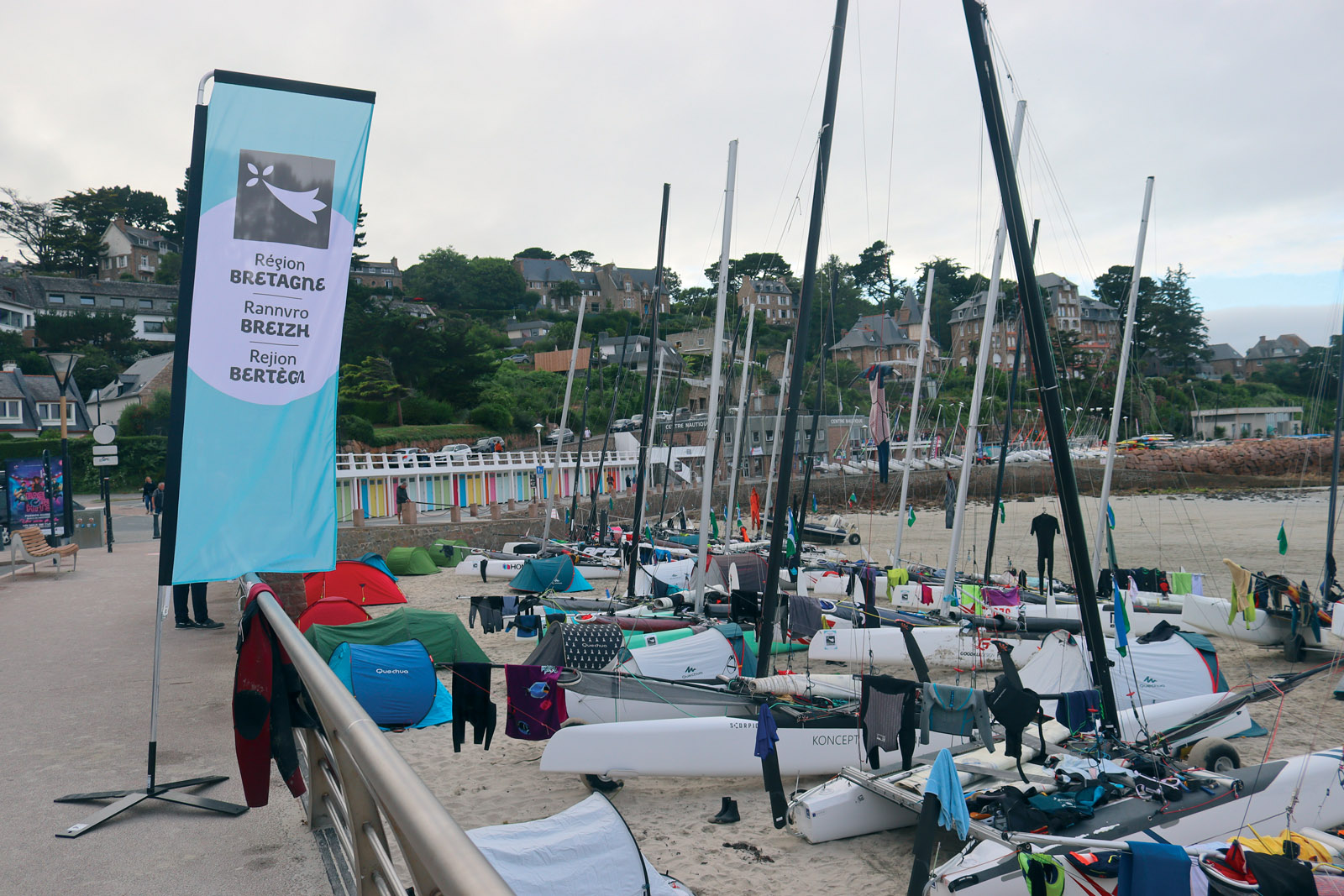
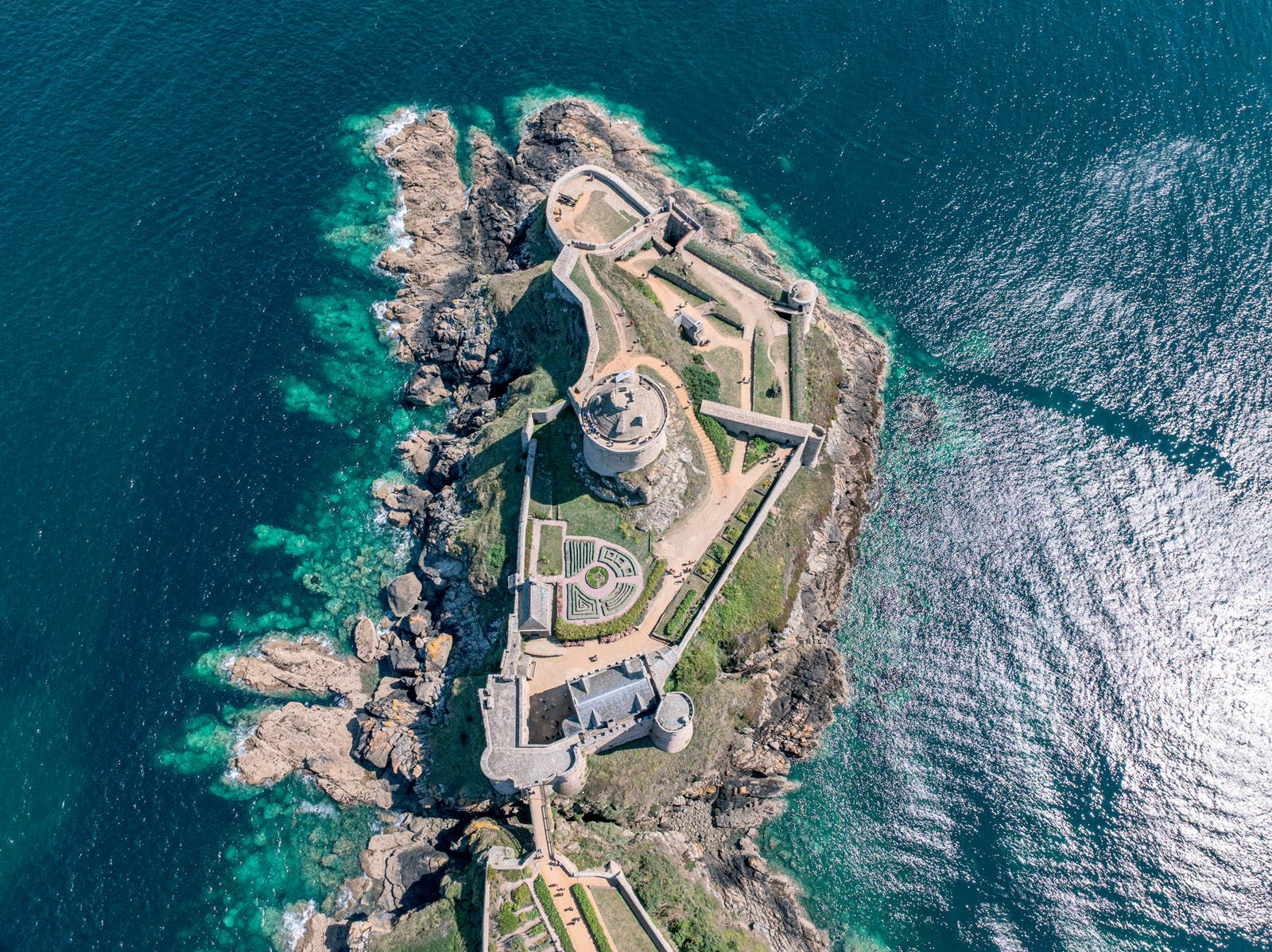
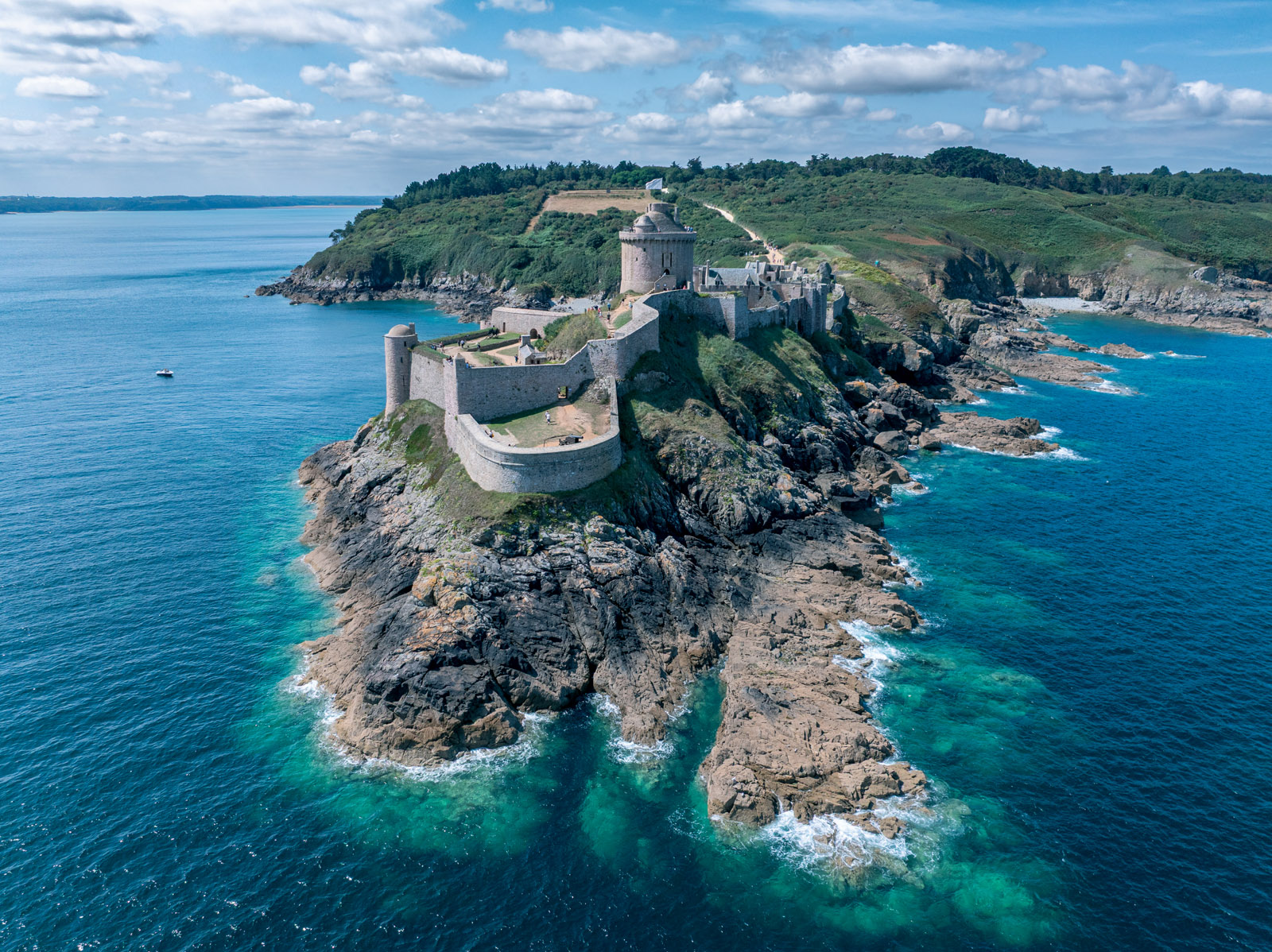
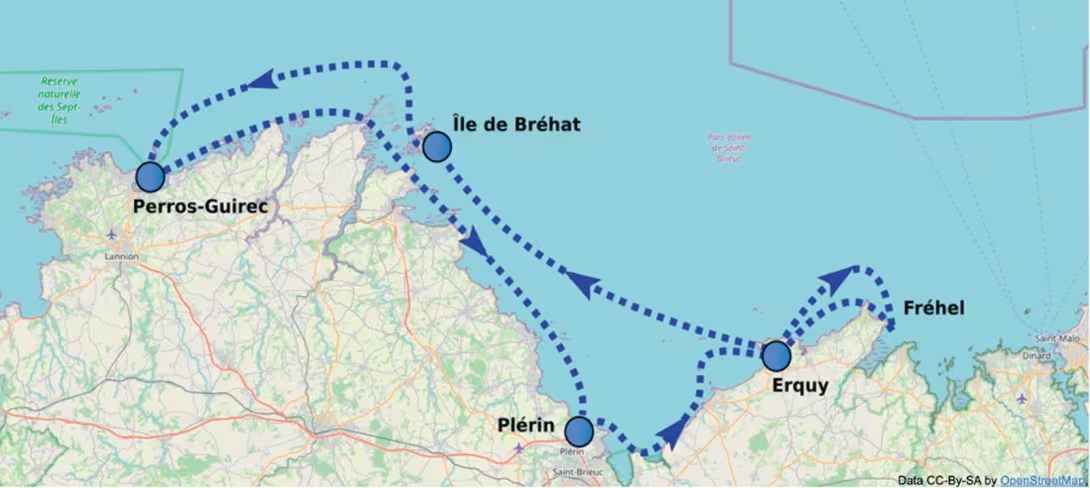
Since 1993, this prestigious yet low-key regatta has been held every year along the Côtes d’Armor coastline on the northern shores of Brittany. The course forms a loop starting from the drying harbor of Erquy, passing via Ile de Bréhat, Perros-Guirec and Plérin, before returning to Erquy. The last stage, with a buoy to round off Fort La Latte, is as spectacular as it is challenging. The course passes through some magical locations, but beware: even though the race takes place every year in late July and early August, conditions can be tough, especially when the region’s strong tidal currents complicate matters. I took part in this event four times between 2010 and 2013, and I have got some extraordinary memories of it: a clever mix of high-level competition, maritime adventures, and sharing some unforgettable good times during the evening stopovers.
Formula 18: Thirty Years of Passion and Evolution
The Formula 18 class, better known simply as the F18, was created in 1993 by Olivier Bovyn and Pierre-Charles Barraud. In charge of catamaran sailing at the French Sailing Federation, their goal was simple and visionary: to create an international class that would bring together the best sports catamarans in a single category, without falling into the trap of rigid or prohibitively expensive classes.
At the time, the lightweight multihull market was fragmented between several brands (Hobie Cat, Tornado, Dart, to name but three), each defending their own turf. The F18 quickly found its place by offering a compromise: a sports catamaran powerful enough to appeal to high-level racers, but financially and technically accessible to a wide audience of enthusiasts.
Unlike one-design boats, the F18 is based on an open class: a few essential rules define the basics, but leave designers real freedom to innovate.
All capable of winning...
This careful balance between freedom and constraint has led to the emergence of a varied but ultimately homogeneous fleet. The Hobie, Nacra, Cirrus, Mattia, Phantom, Exploder, and Goodall shipyards have each offered their own models, all capable of winning. The result is a class that is competitive, fair, and sustainable. In many ways, the Formula 18 shares a similar vision with one of the iconic monohull boats, the Class40. This was created in 2004 to meet the growing demand from sailors wanting to race offshore without astronomical budgets, and imposed a clear and restrictive rule, deliberately closed to certain costly innovations such as foils. The F18 has followed the same logic. Where other multihull classes have embarked on a frantic race for innovation, sometimes at the cost of rapidly obsolete fleets, the F18 class rules are somewhat conservative. No foils allowed, no expensive exotic materials, no technological one-upmanship...
The goal is simple:
• Preserve the simplicity and uniformity of the existing fleet so that older models can still participate in races.
• Limit cost inflation in order to keep the class accessible to as many crews as possible.
• Maintain a universal spirit, where the pleasure of sailing and camaraderie are just as important as pure performance.
As in Class40, you don’t have to be a top athlete or a sailing professional to enjoy an F18. Of course, the world’s best compete at the highest level, but the rating system also allows knowledgeable amateurs, couples, and mixed crews to take their place on the startline. This intergenerational accessibility and the opportunity for amateurs to compete at the highest level are the keys to the Formula 18’s enduring success.
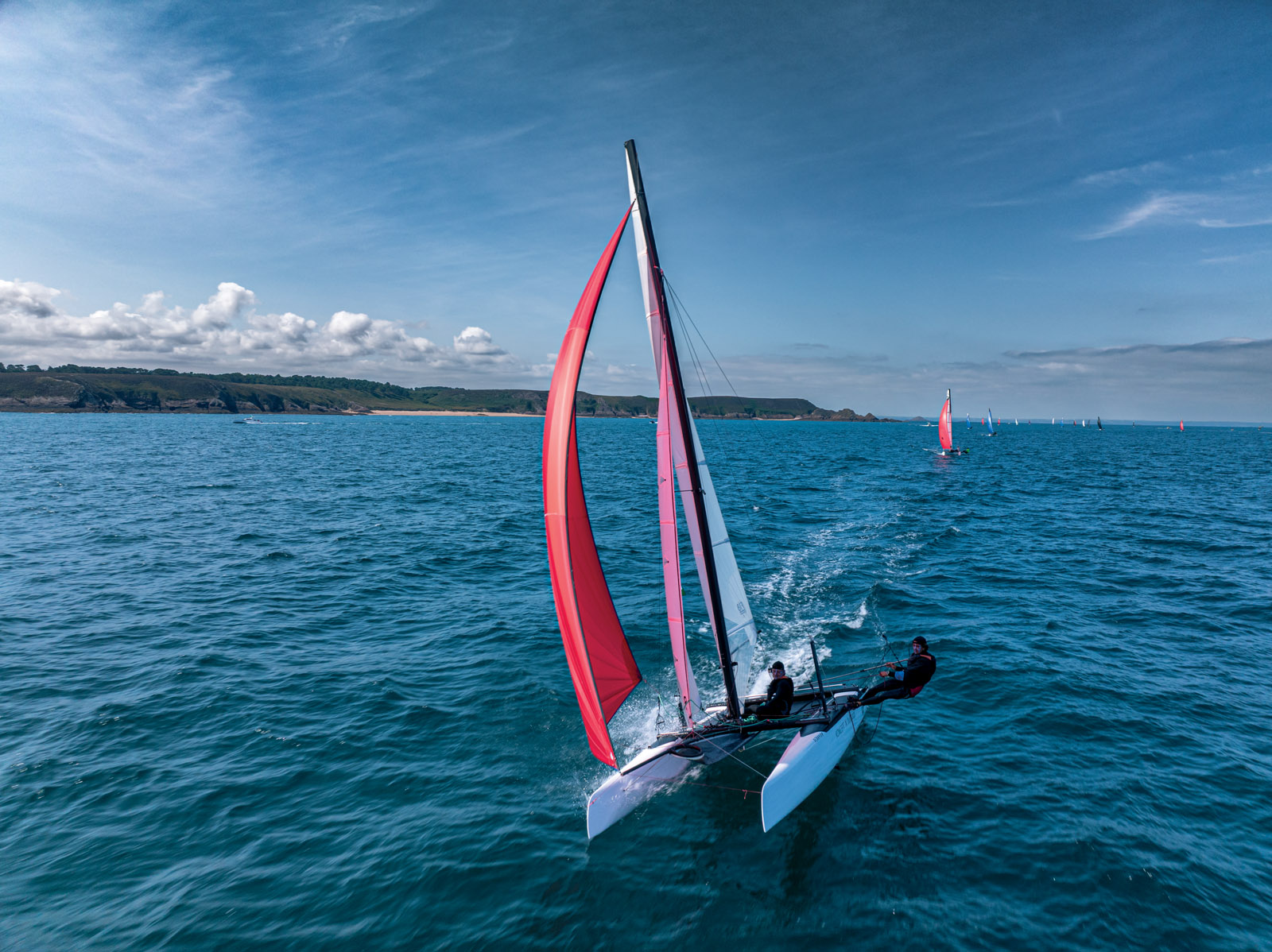
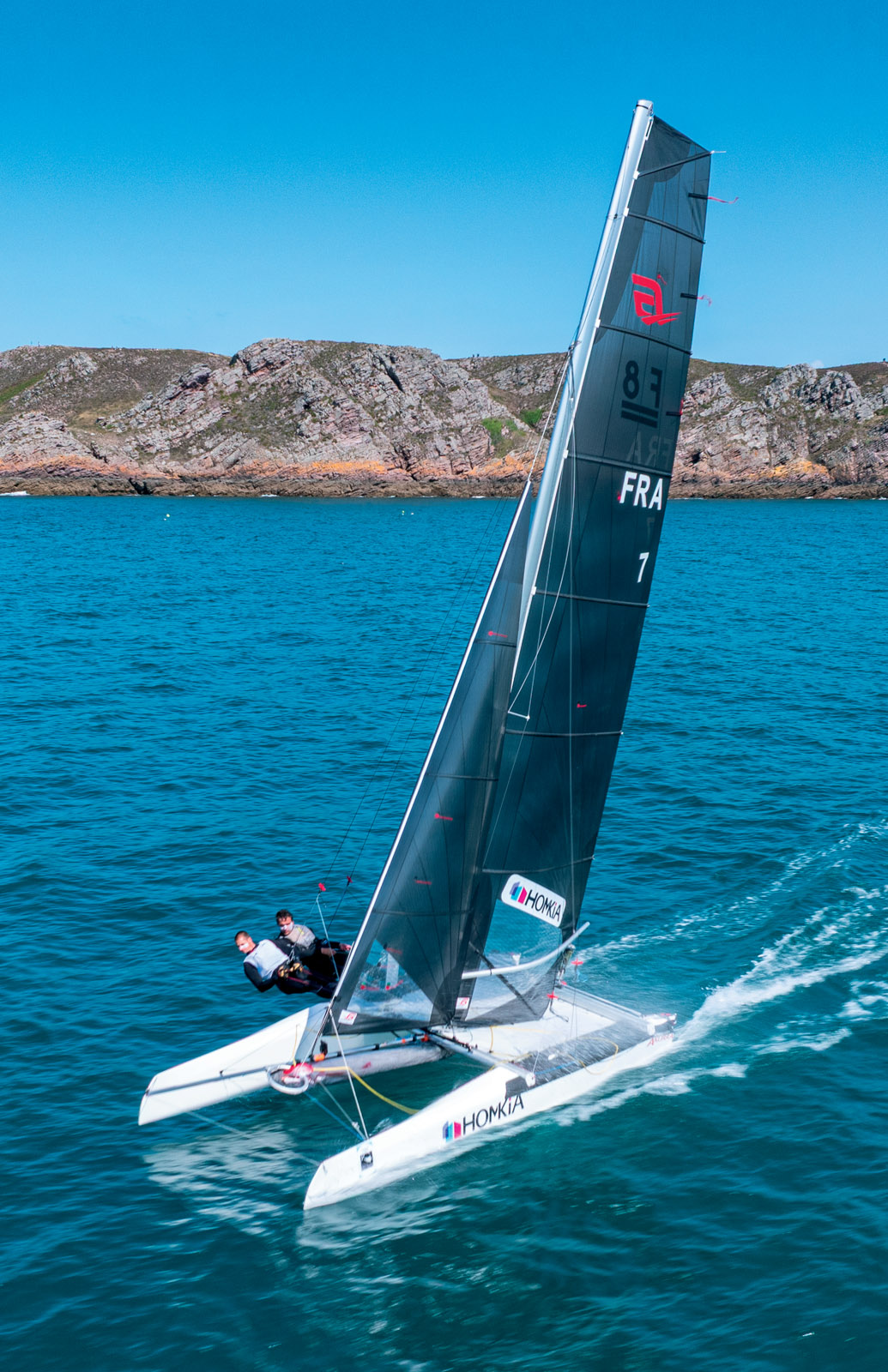
But the F18 remains a thrilling multihull. Capable of speeds of over 20 knots when reaching, it is maneuverable and remains safe in rough conditions thanks to its relatively high minimum weight. To perform well, however, it requires a perfectly coordinated crew:
The one on the helm must remain focused on the course and sail trim, whereas the crew member on the trapeze is responsible for the balance and power of the catamaran, while also managing tactics.
This complementary nature makes the F18 both a physical and technical challenge, attracting a wide variety of profiles, with young people from Olympic backgrounds to seasoned sailors looking for a new adrenaline rush.
In its thirty years, Formula 18 has seen an entire generation of top-level sailors pass through its ranks. Australians Darren Bundock and Glenn Ashby, both world champions in the discipline, have become big names in the America’s Cup. Dutchman Mitch Booth, an Olympic medalist, also left his mark on the class’s early days. In France, Olivier Backès and Arnaud Jarlegan shone with a world title in 2010, while Franck Cammas, always hungry for speed, was crowned world champion in F18 raids in 2020.
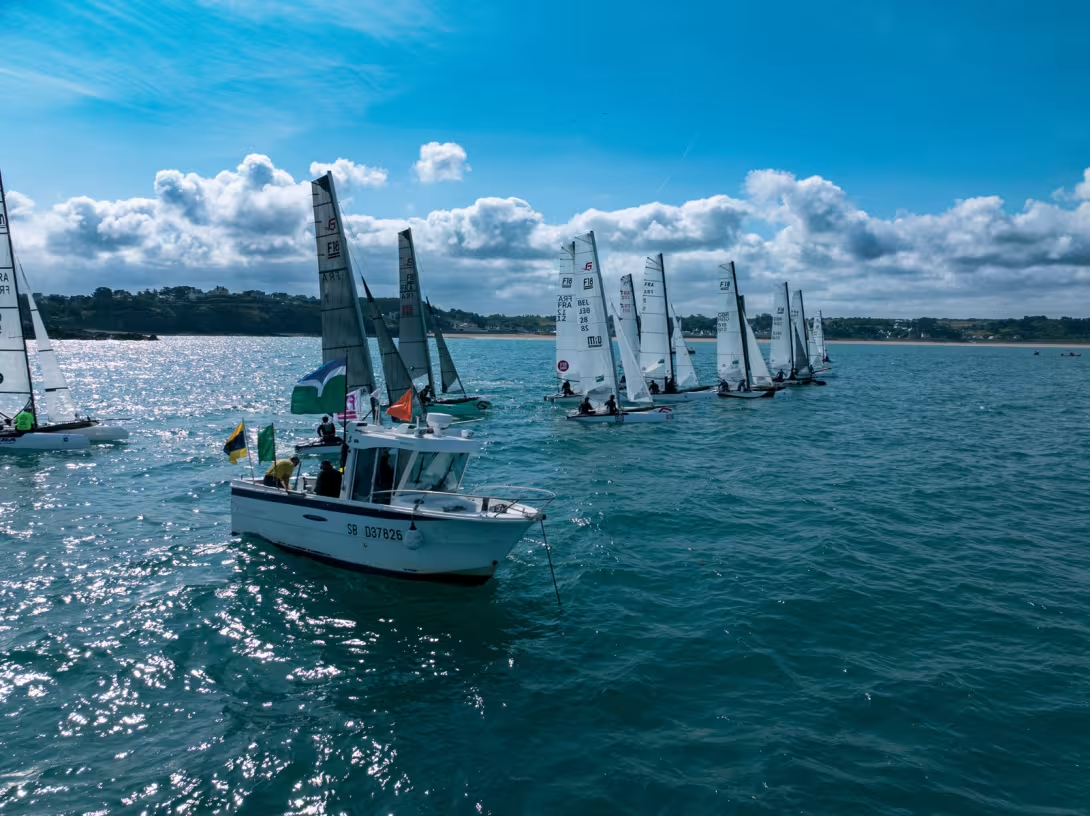
The level of competition is so high that the world championships regularly attract more than 100 crews from all over the world, offering racing of rare intensity. For this year’s edition, among the 25 entrants, Charles Caudrelier was the guest of honor, waiting for his new Ultim Edmond de Rothschild trimaran to be launched in September.
While the F18 shines internationally on constructed courses, it is also very popular in France in long-distance events: the Eurocat in Carnac, the Catagolfe in the Gulf of Morbihan, the Raid Emeraude in Saint-Lunaire, the Tour de la Martinique and the Saint-Barth Cata-Cup in the West Indies, and of course the Costarmoricaine, which serves as the French F18 raid championship each year. It should be noted that on the Costarmoricaine, a few Vipers, 16-foot one-designs that are slightly less physical than the F18s, are invited to participate with a separate ranking system.
A 175-nautical mile Course... Among the Rocks
The 2025 Costarmoricaine set sail from Erquy for a five-stage trip covering most of the Côtes-d’Armor coast, a total of nearly 175 nautical miles.
The first stage took the fleet to the archipelago of Ile de Bréhat. It’s a demanding warm-up: the fleet must cross the Bay of Saint-Brieuc to reach the Roselière buoy, then sail between the rocks between Saint-Quay-Portrieux and Paimpol.
I’ve got fond memories of the 2010 edition, when a heavy squall caught the fleet off Cormorandière and some of the less experienced crews ended up upside down or even dismasted, which was my case after falling flat on my back onto the bowsprit...
From Bréhat, the course continues towards Perros-Guirec, sailing along the spectacular Côte de Granit Rose [the Pink Granite Coastline] with the often-challenging Phare des Héaux de Bréhat lighthouse as a mark of the course. This year, ideal wind conditions prompted the organizers to send the fleet on a leg of 40 miles! Now that’s a long one!
Arriving on the long beach at Trestraou is always a highlight, both sporting and festive.
The third stage links Perros-Guirec to Plérin, passing between Bréhat and the coast. It’s a speed stage that is often sailed downwind, so beware of going off course as it can ruin any chance of victory!
On the fourth day, the fleet returns to Erquy, after sailing up the coast to the Mauve rock and crossing the entire bay. In its long version, with the extra 40-mile leg, the crews are exhausted when they cross the finish line!
Finally, the fifth day offers a final rounding of Cap Fréhel, passing in front of Fort La Latte. This final mark, as iconic as it is decisive, often acts as the justice of the peace, as, once past the cape, the shifting winds are quite capable of shaking up the overall rankings—putting the competitors’ nerves to the test!
Perfecting Maneuvers
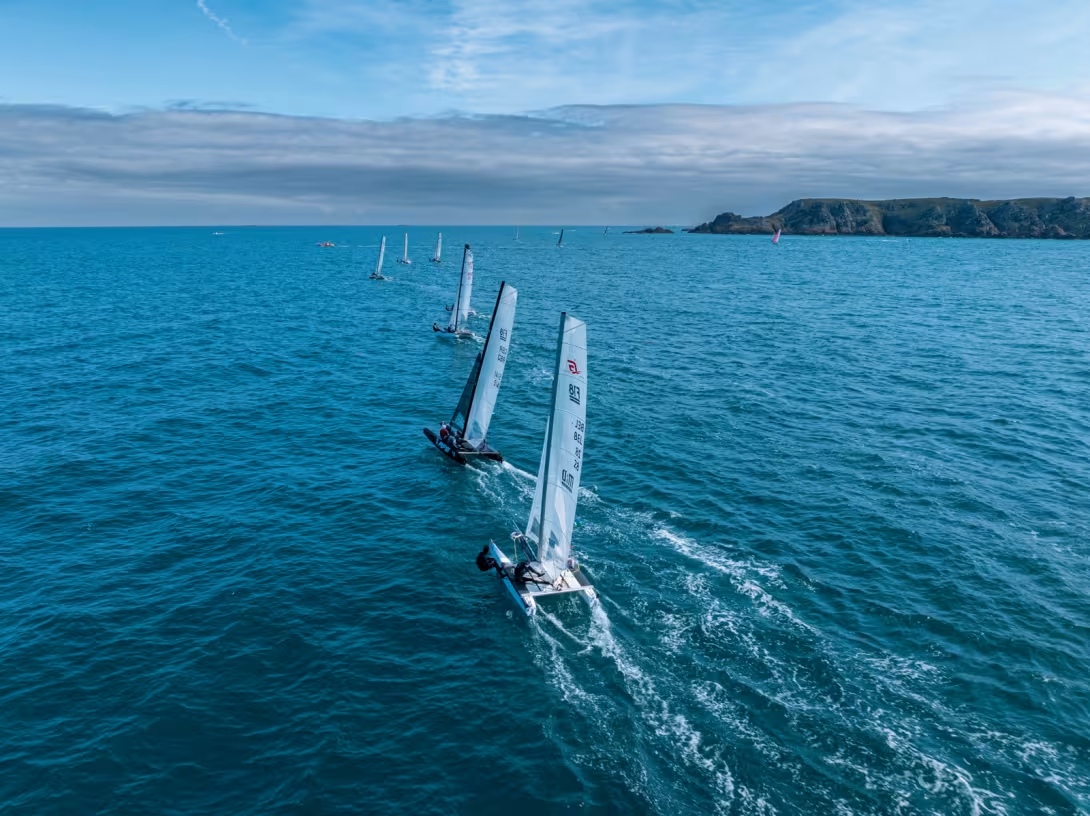
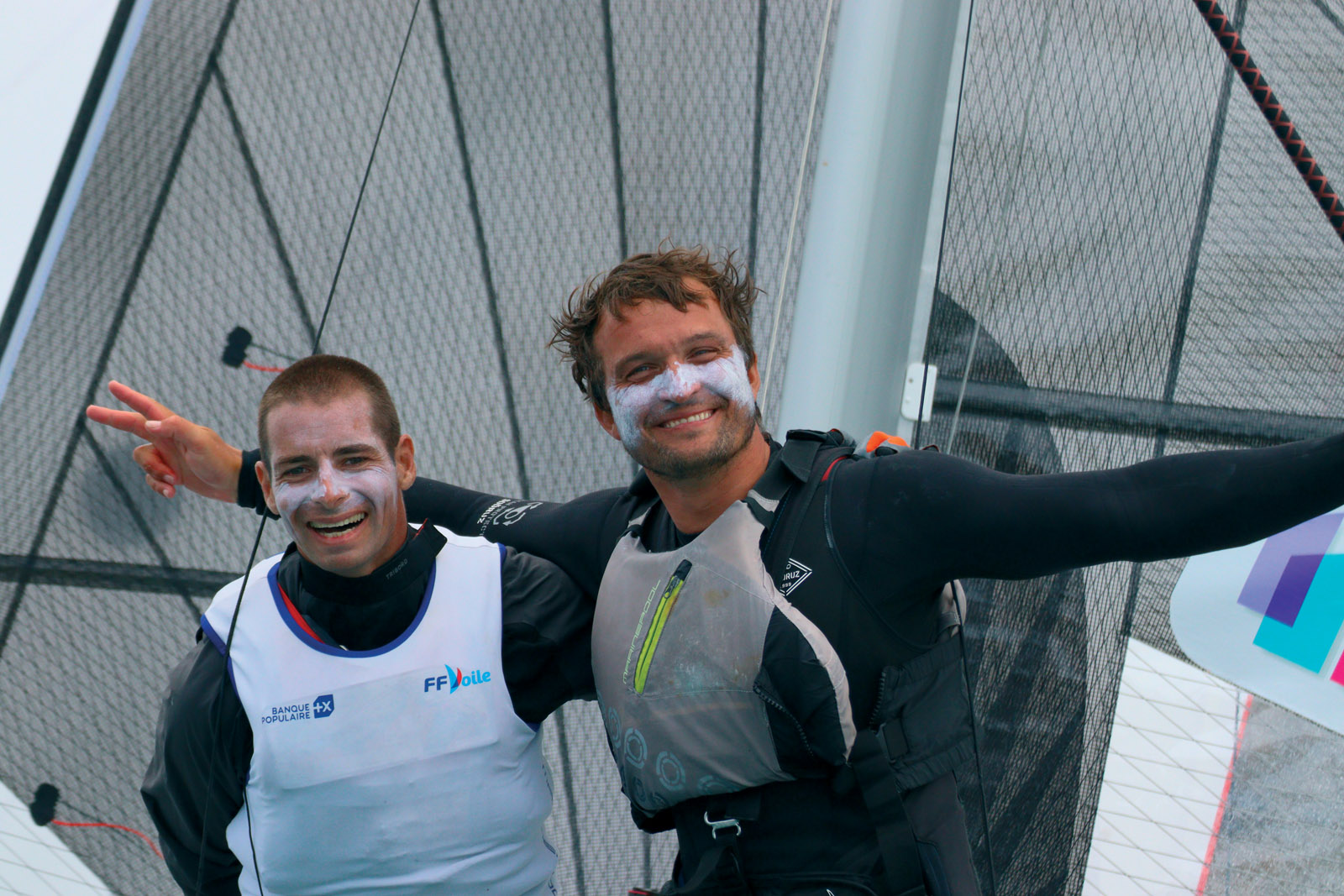
This year’s Costarmoricaine was largely dominated by Emeric Dary and David Fanouillère, two great F18 specialists and regulars at the event (6th participation for Emeric, 7th for David, including 3 they’ve done together). Emeric told me that they’d trained hard aboard his Akurra, notably by participating in the F18 World Championship in the Netherlands, where they came 12th out of a fleet of 96, back in early July. I was lucky enough to be able to film the last two stages with a drone, and the level of perfection in this duo’s sailing maneuvers is clearly a grade above their closest competitors.
As for the race results, they achieved a grand slam by winning every leg!
Of the 19 crews finally classified in F18, there were four British crews, two Belgian crews, and a couple of brave Austrians who preferred to make the trip to Brittany rather than compete in the World Championships in the Netherlands, which was much closer for them. It should be noted that the four British crews made it into the top 10 because they train hard and all use the same model, the Edge.
Coming in fourth were the Masurel brothers, Timothée and Augustin, from the Cercle de Voiles de Jullouville sailing club. They’ve taken part in almost every edition since 2010. The two “young” forty-somethings, who each work in senior roles in Paris in addition to being involved in their family lives, only participate in a few races a year, rarely more than three, but that didn’t stop them from achieving this very impressive fourth place. There were also couples or father/son or father/daughter crews, bringing great diversity to the event.
Conclusion
If you’re a fan of sailing on two hulls, and burning calories rather than sunbathing on the beach, and aren’t afraid to compete at a high level, then you absolutely must take part in the Costarmoricaine! As for me, all that’s left to do is get back into some serious physical training so I can be on the startline again next year...
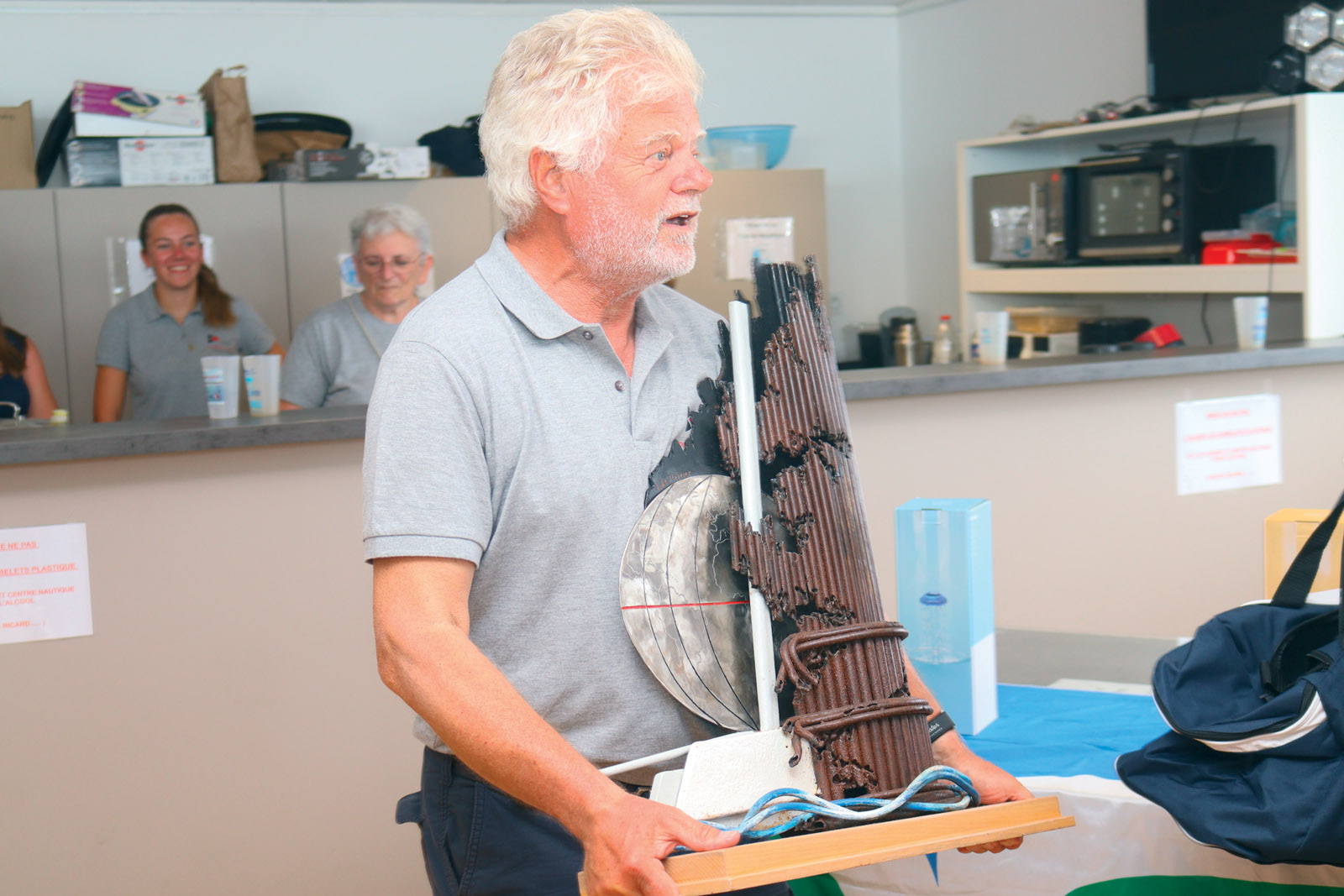
Olivier Bovyn Co-founder of the Costarmoricaine... and the F18 Class
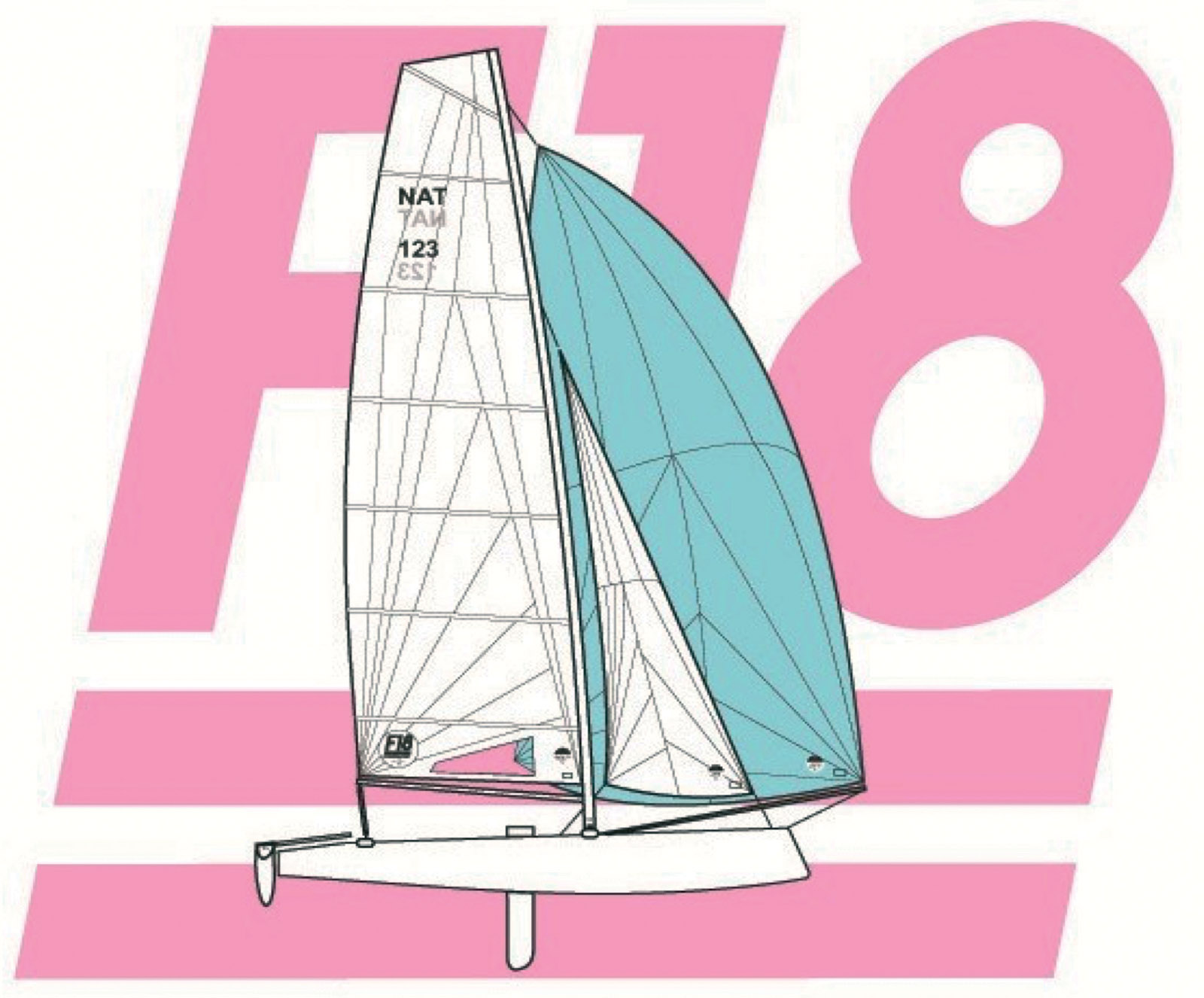
Beam: 8’6” (2.6 m)
Minimum weight: 400 lbs (180 kg) – thus avoiding the race for extreme lightness
Sail area: 183 sq ft (17 m²) for the mainsail; 44.7 sq ft (4.15 m²) for the jib; 226 sq ft (21 m²) max for the spinnaker