
For sailors from all four corners around the world, French Polynesia is something of a nirvana, a holy grail for circumnavigating cruisers. I’d been enthralled by the stories of Bernard Moitessier, Paul-Emile Victor, and Alain Gerbault. But is it true that French Polynesia no longer resembles the description given by Bougainville in the 18th century? The only way to find out for sure was to go and check it out for myself. The problem is that the call of the South Seas comes at a price, and chartering a private catamaran is not within everyone’s budget. So when I saw that Dream Yacht was offering 11-day cabin charters in the Society Islands aboard a spacious Lagoon 620 crewed by locals, I didn’t hesitate.
Before heading off, I was inevitably wondering if the magic would still be there. We’ve all dreamed of it since childhood, this mythical Pacific Ocean that covers nearly a third of the planet. I had read everything I could about French Polynesia and sailing among these 118 sublime islands spread across five archipelagos, scattered across a maritime area half the size of the United States.
€ 7,200 for a Double Cabin, Full Board
For me, it was to be Tahiti, Moorea, Huahine, Raiatea, Taha’a, and Bora Bora. The compromise seemed ideal to me: sure, I was going to have to share the catamaran with strangers, but the comprehensive itinerary would allow me to see almost all of the islands in the best conditions, without wasting time organizing the charter, provisioning and cooking, shore excursions, all the formalities, transportation, etc. And even though there’s pleasure to be had planning your own trip, being able to rely on a skipper who knows the waters, the dangers, the best anchorages, and the weather conditions well gave me the opportunity to fully enjoy a contemplative cruise without worrying about a thing. It seemed idyllic on paper, and very advantageous financially: €7,200 for a double cabin with full board (the optional shore excursion package costs €550 per person). No matter how many times I did the math, the budget/peace of mind ratio was unbeatable. The favorable season was well placed in my calendar: at the beginning of April, the warm southeast trade winds would soon set in. And of the six cabins on the latest Lagoon 620, which was not fully booked, only one was still available: I quickly decided to book it. Note: the charter company offers the same service with Bali 5.4s. All that was left to do was throw a few swimsuits in my suitcase and travel the 12,000 miles that separated me from Papeete. I’ve been sailing for 30 years but never has a cruising departure been so serene. I needed to bring almost nothing, trusting completely in the good reputation of the world leader in charter, and relieved that I hadn’t (completely) emptied my bank account. I reckoned I was off to a good start!
Lagoon 620: An Incredibly Comfortable Catamaran
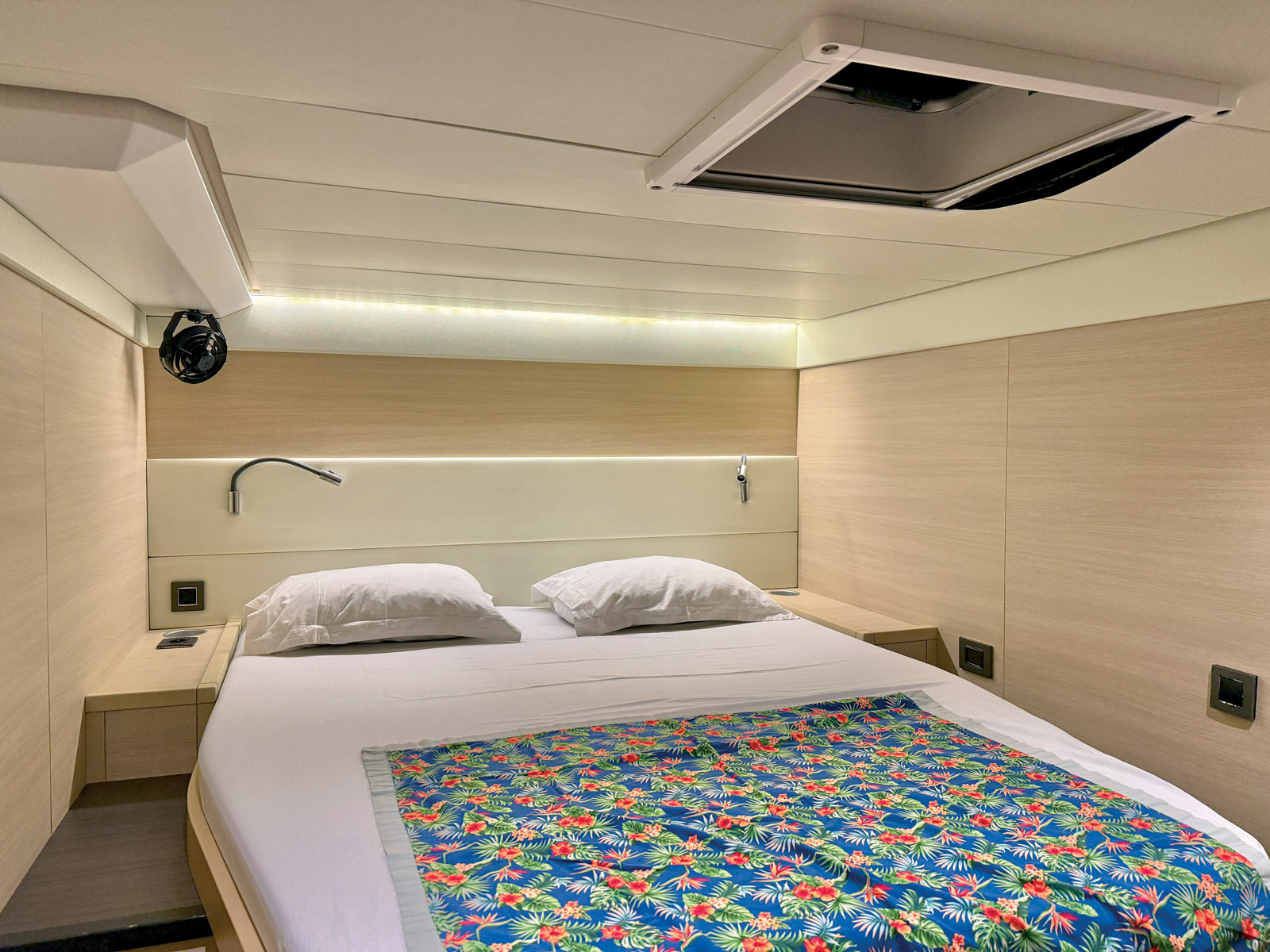
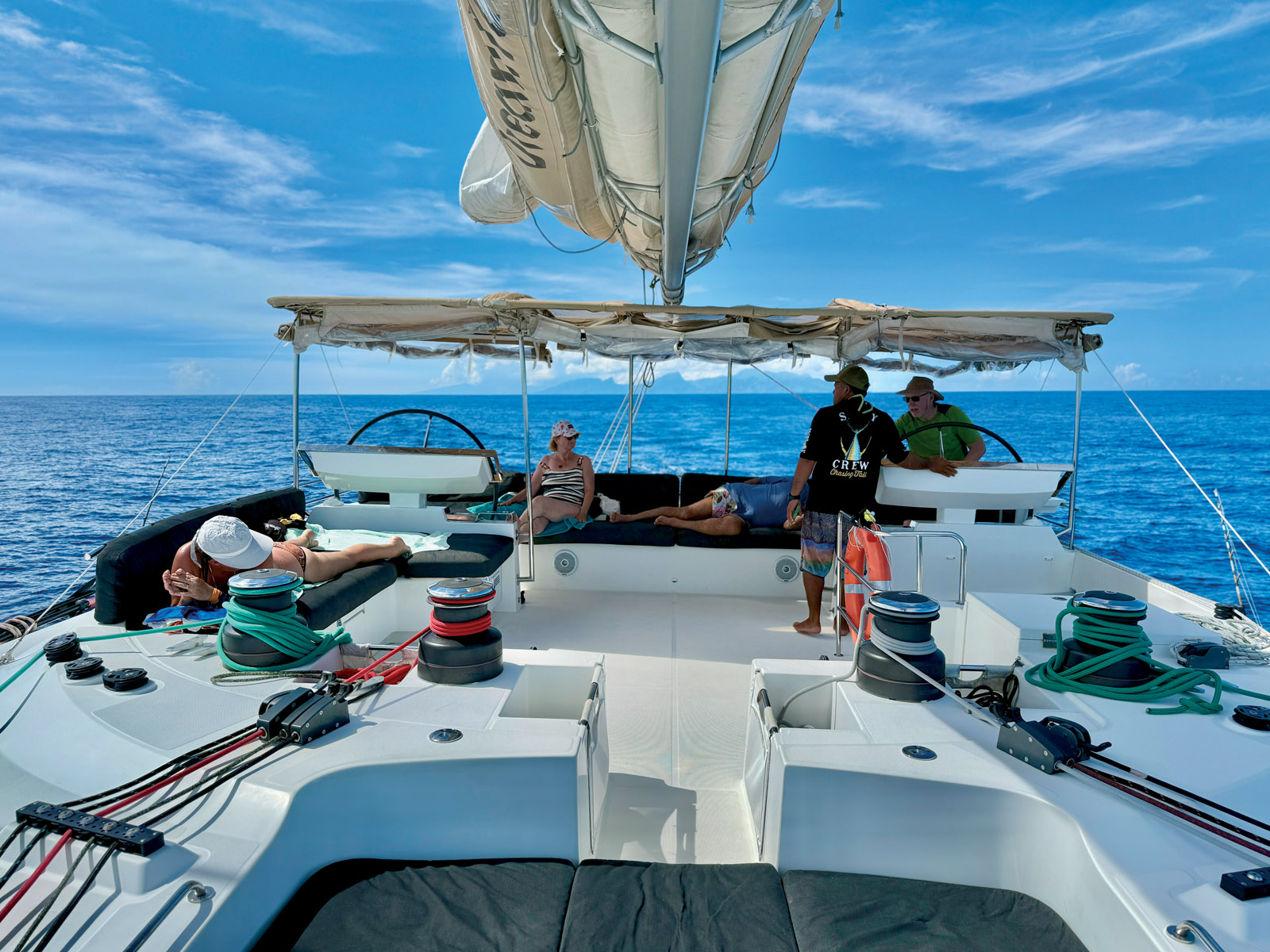
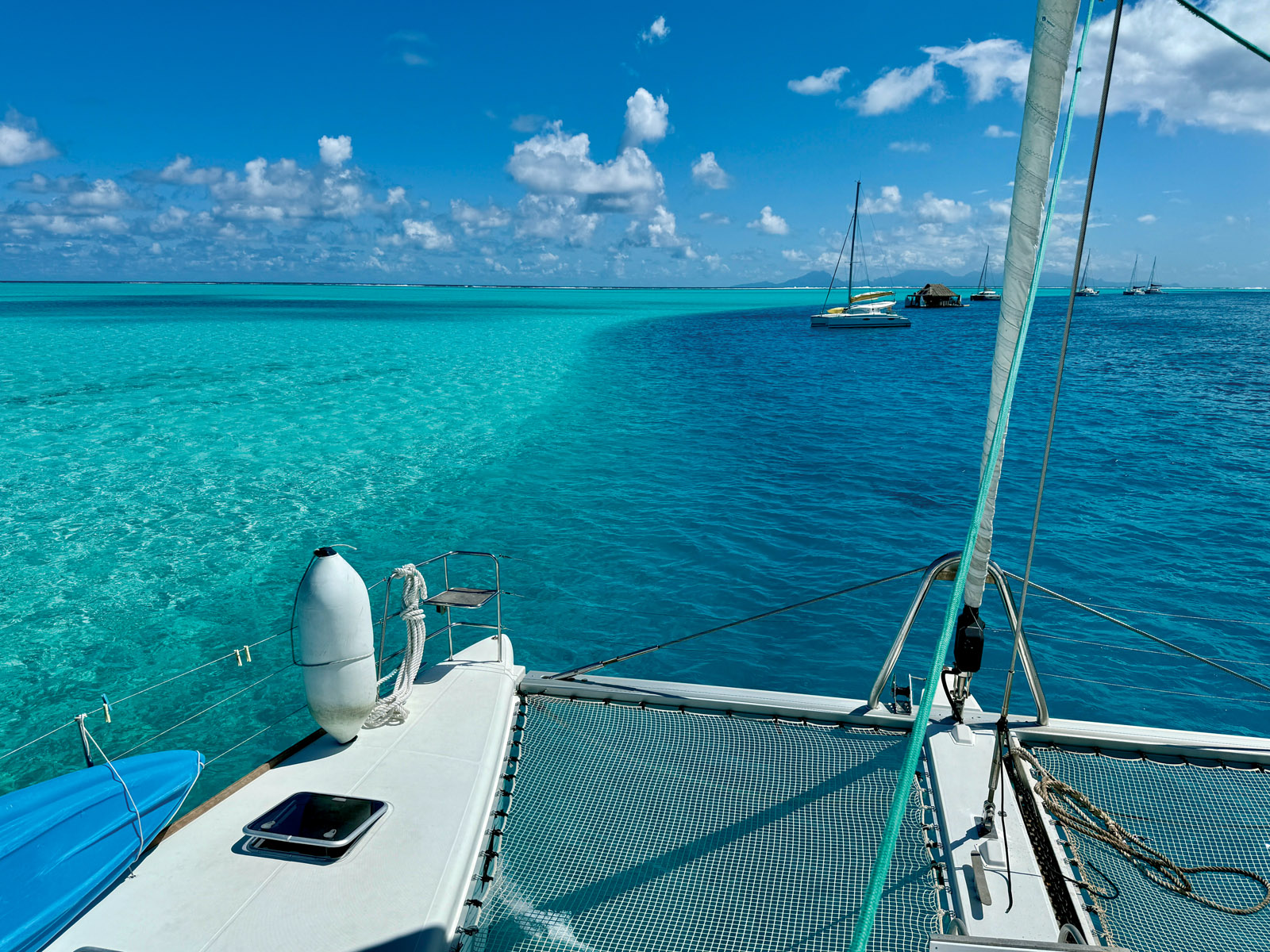
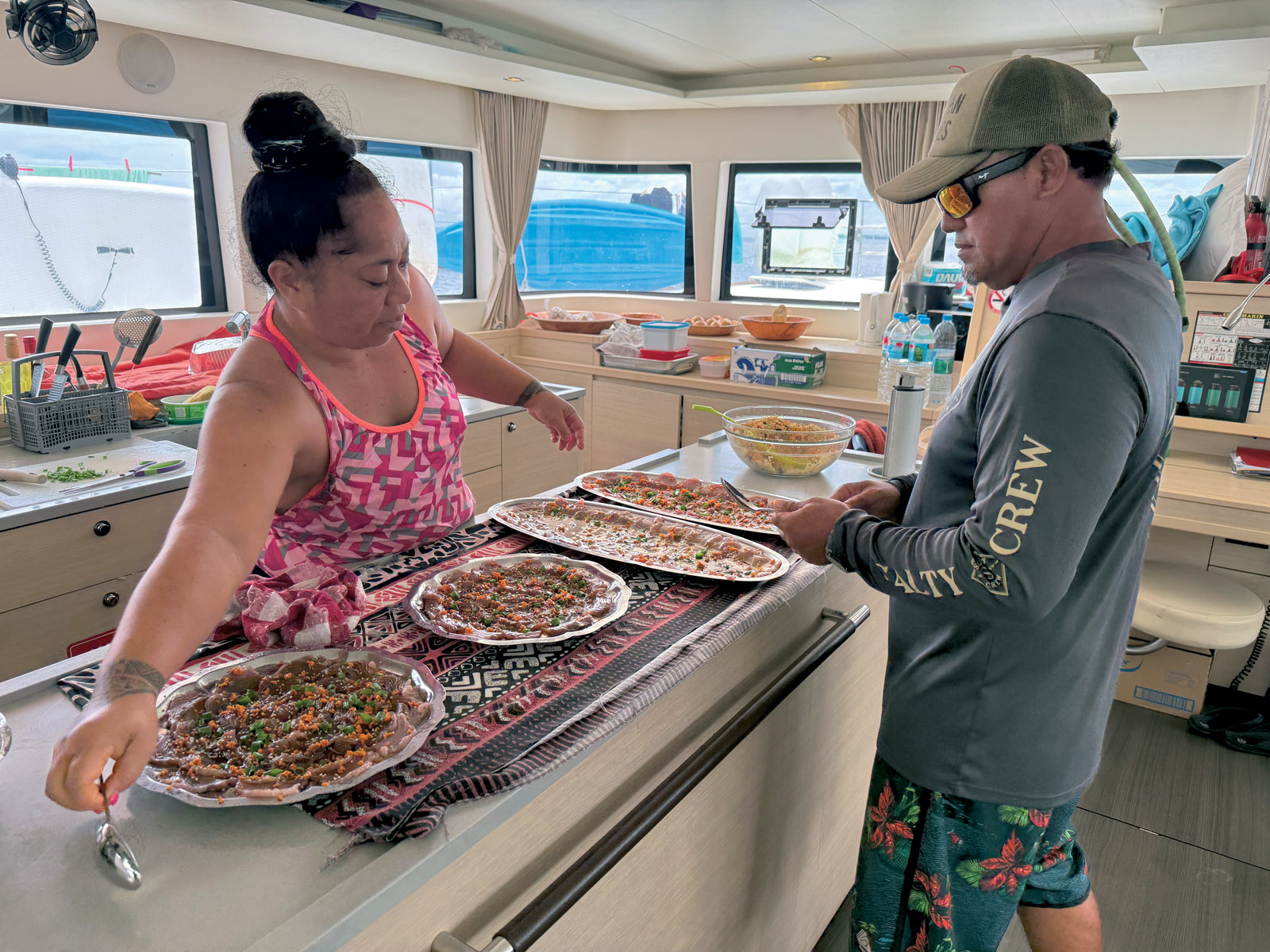
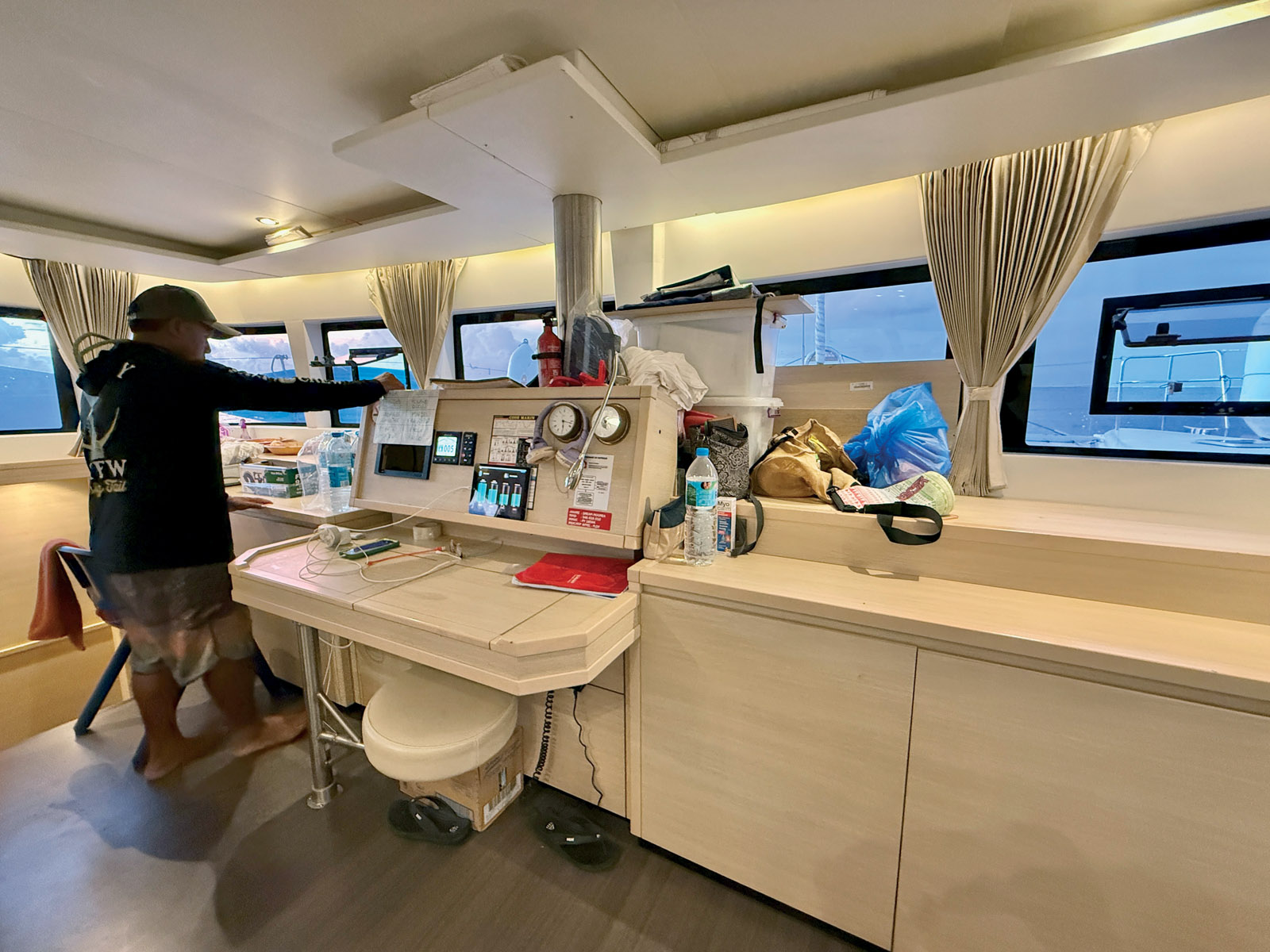
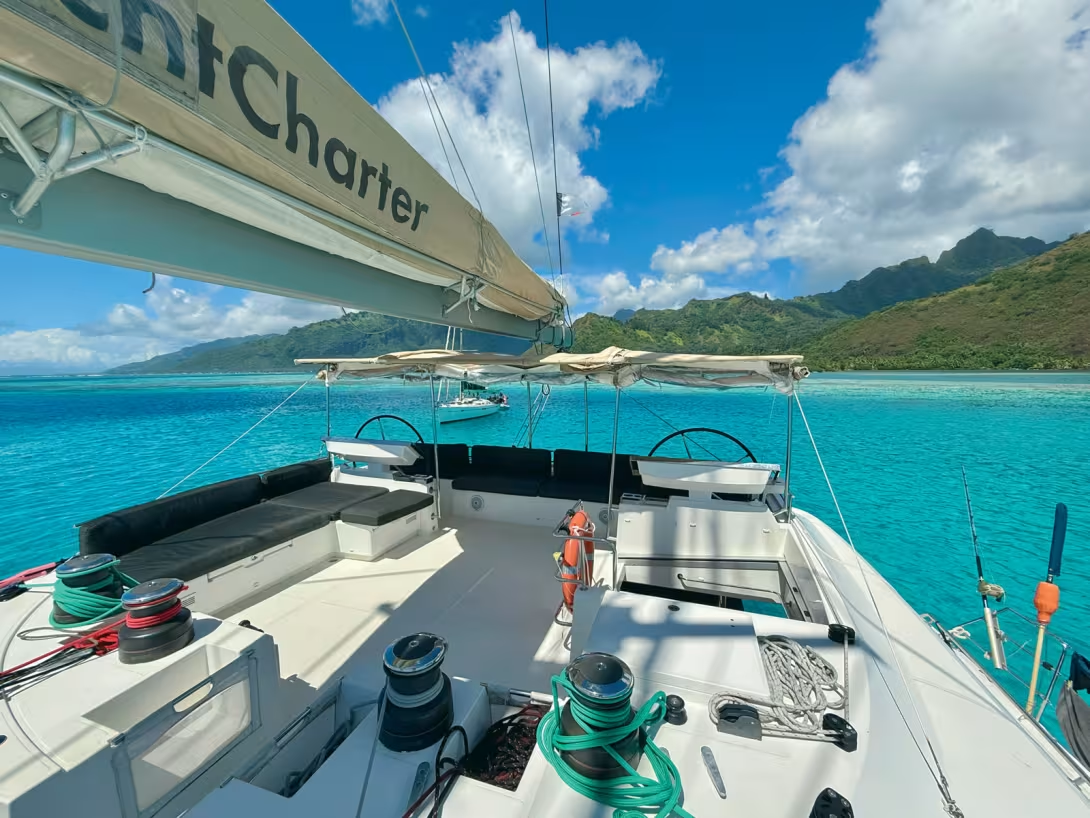
Maeva Tahiti (“Welcome to Tahiti” in the local language)! Arriving at Marina Taina, I was amazed at the size of the Lagoon 620 moored at the dock. I’m not used to craft of this size, and any apprehension I might have had about being crammed in with the other charter guests instantly evaporated. The cockpit and living areas are huge and functional, and no one would be stepping on each other’s toes: it would be easy to get a bit of privacy if I wanted it. The flybridge, with its bimini top and double helm station, is full of thickly cushioned bench seats and daybeds, offering a promising 360-degree panorama from this well-designed sun lounger. The out-sized deck hardware, the huge mast, the almost twenty-six hundred square feet (241 m2) of sail area, and wide side decks speak volumes about the robustness of this catamaran designed for ocean sailing. On board, there is all the necessary snorkeling gear, as well as a kayak and a paddleboard. The 12 passengers were warmly welcomed in the outdoor lounge with a snack prepared by our hostess Vaea, whose dazzling smile shone beneath a cascade of shiny black hair. She is also the wife of our skipper, Wen. He briefed us on safety and the detailed program for our 11-day trip before assigning us our respective double cabins. These were very comfortable, equipped with air conditioning, a private bathroom, and plenty of storage space, and are also bright thanks to light-colored paneling, long portholes, and Goïot hatches. The queen-size bed is excellent... in short, I found myself in a veritable floating guest house! As for our crew, I liked them straight away: Wen and Vaea, both Polynesians, form a duo that feels as smooth as clockwork—in the days that followed, I could only note how wonderfully well they function together. They’ve been working together for nine years, seven months of the year, and know all the various catamarans at the base like the back of their hands. Their experience, kindness, and desire to share with passengers are instantly apparent. We were definitely in good hands.
The Jagged Peaks of Moorea
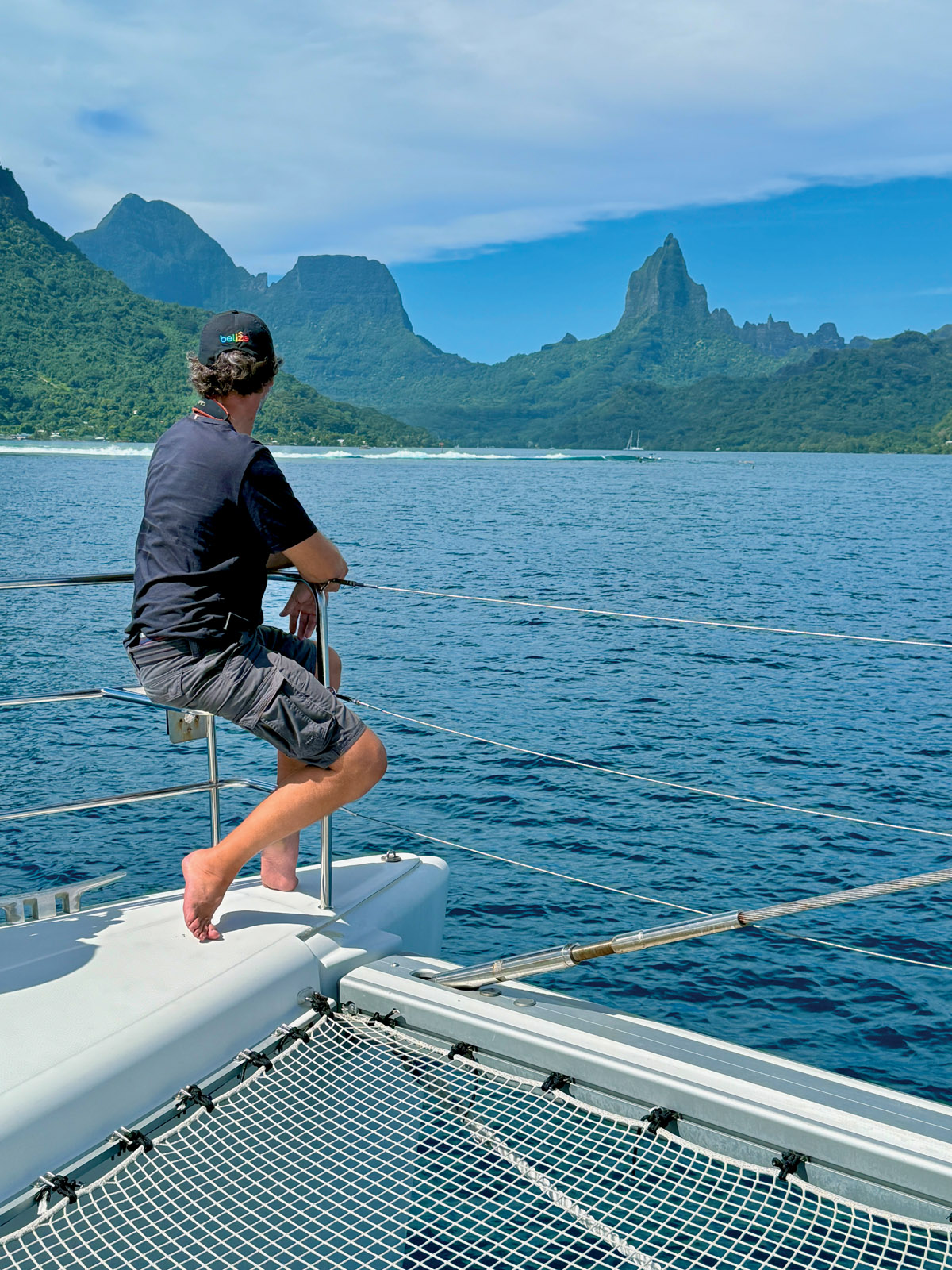
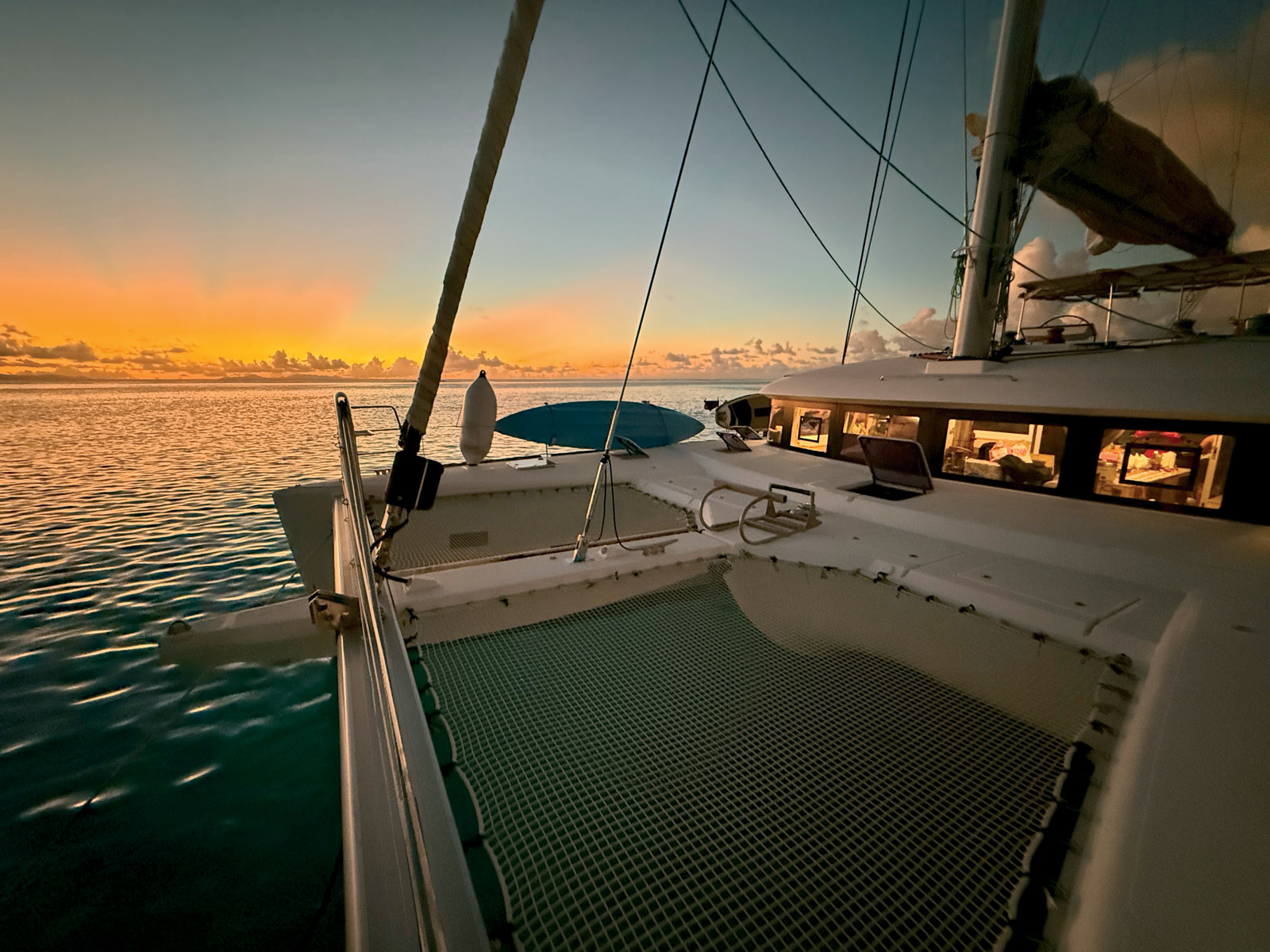
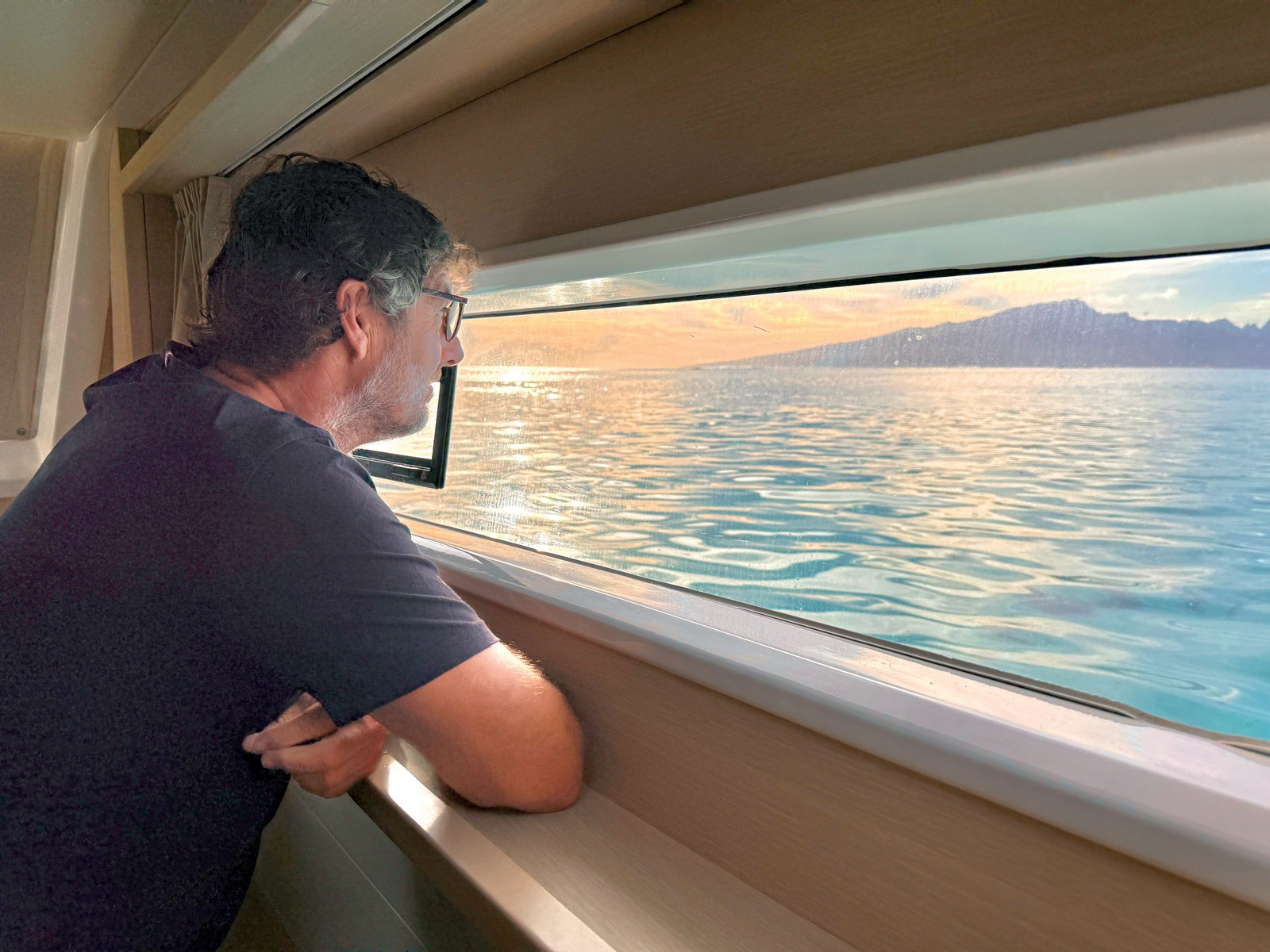
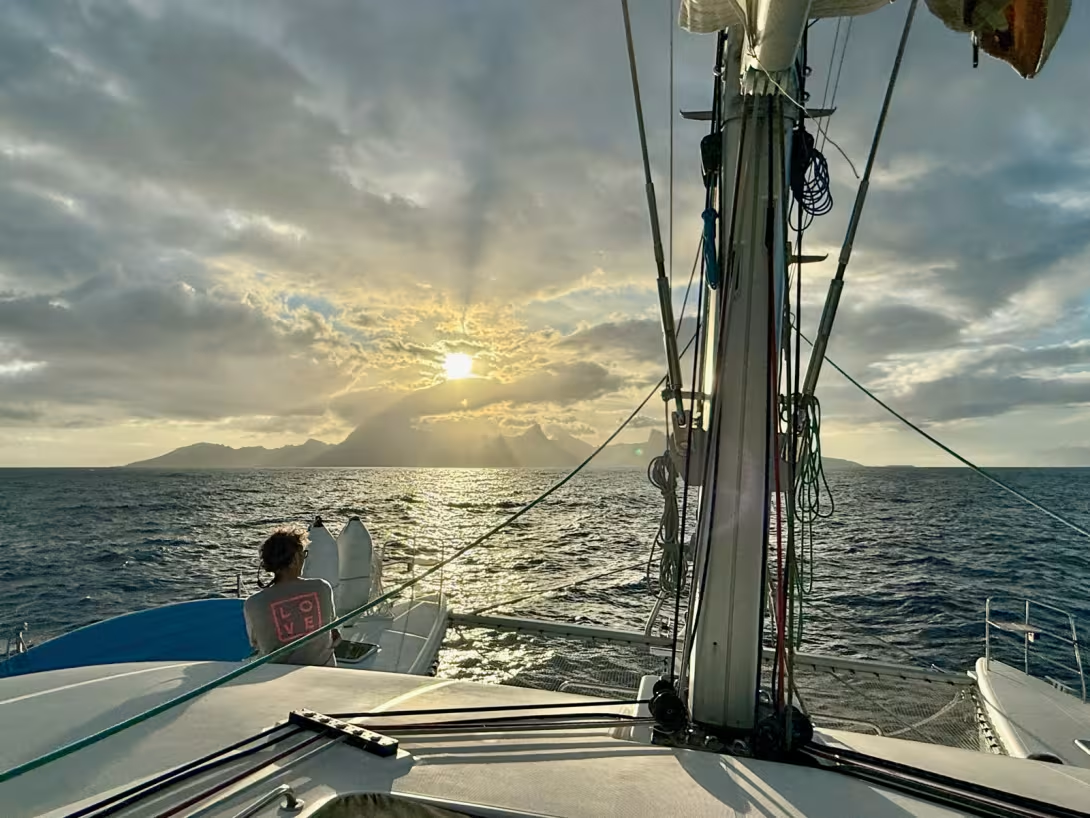
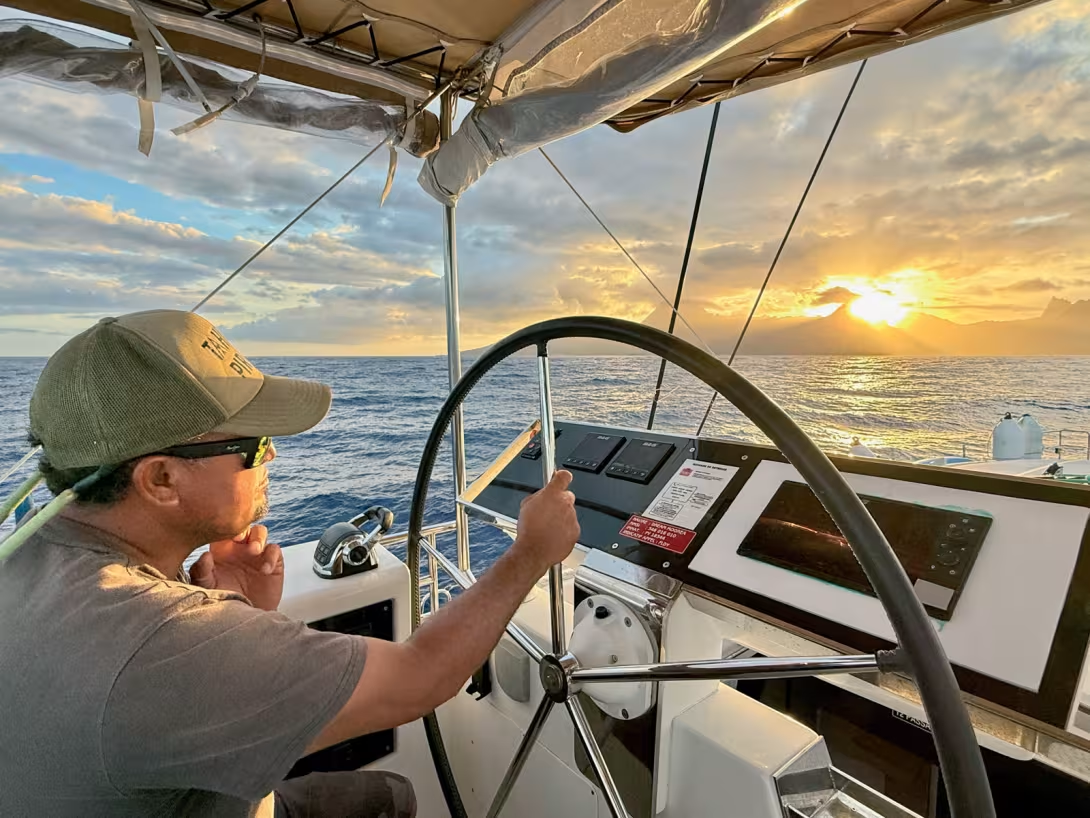
We cast off without delay, leaving Tahiti, its 280,000 inhabitants, its black volcanic sand shores, and its mountains covered in an inextricable tangle of vegetation in our wake. That first night, we would sleep at anchor in Moorea, in Vai’are Bay, about ten miles distant. Hypnotized by the majestic sight of its jagged peaks silhouetted against the setting sun, I could hear in my head the music of Vangelis that accompanies the film The Bounty starring Mel Gibson. The play of light is incredible, reflected in Wen’s glasses as he maneuvered the boat while telling us about sailing conditions in the Society Islands during the high season (May through October), when the climate is drier and cooler. Between November and, it’s the rainy season and temperatures can sometimes be stifling. Once anchored, our first dinner, delicious and convivial like all those that were to follow, was an opportunity to get to know the other guests better: half of them already had sailing experience, while the others were discovering life on board for the first time. They were surprised to find themselves already finding their sea legs: Vaea explained that the Lagoon 620 is so stable that it’s almost impossible to get seasick. For everyone, it is a bit like “the trip of a lifetime”. I lay down on the trampoline, illuminated by the enormous full moon, which hung like a lighthouse in a sky studded with thousands of stars. The lights of Tahiti twinkled in the distance, and I was already beginning to feel intoxicated by the atmosphere of our first passage. I watch Vaea and Wen working deftly in the large open-plan galley that faces the air-conditioned saloon. Serving 36 meals a day for 10 days is quite a logistical feat!
Perfect Anchoring Conditions
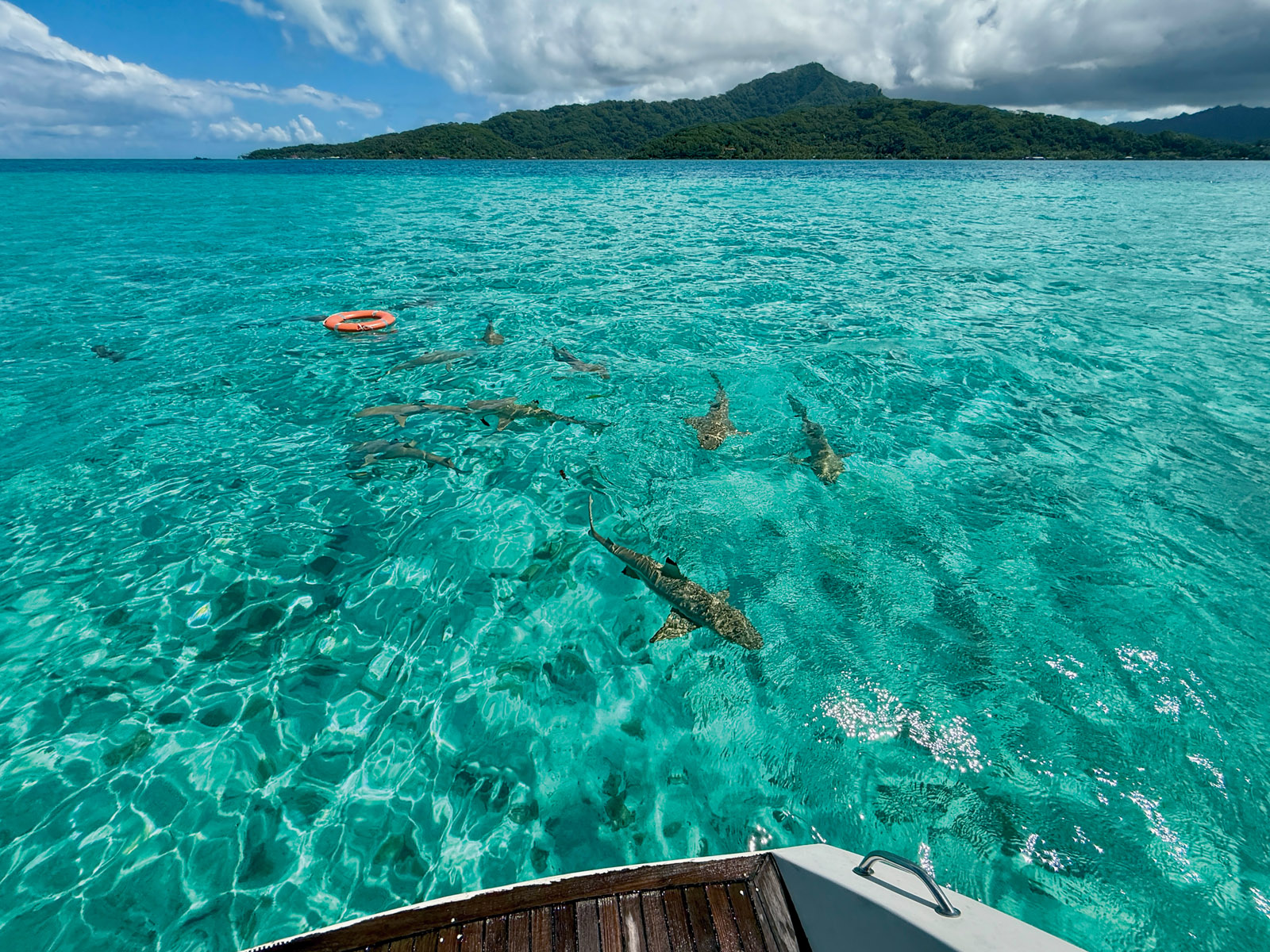
Waking up the next morning, our first instinct was to jump into the water from the ladders at the stern of the Lagoon 620: a ritual that was to become a daily occurrence, because it was for this calm, jade-colored water, clearer than that of a swimming pool, home to so many species of multicolored fish, corals, crustaceans, and mollusks, that we had come. The anchorage conditions were perfect in this XXL-sized aquarium with its ideal temperature water, white sandy bottom and excellent holding, sheltered by coral reefs. Two bays cut deep into this 50-square-mile (132 km2) island, which together with Tahiti forms the Windward Islands: Cook’s Bay and Opunohu Bay, both of which are picture- perfect with their legendary steep mountains rising to 900 meters (almost 3,000 feet). We dropped anchor alternately to snorkel in the coral garden, watching parrotfish and boxfish, triggerfish, green turtles, stingrays, and blacktip reef sharks parade across in front of our masks. The blacktips are not aggressive in the slightest and are even rather timid. We rubbed shoulders with them throughout our stay without ever tiring of them. I realized that beyond the postcard image, there is a whole ancestral culture centered around the sea to discover: the Big Blue is found here, in the lagoon, which the Polynesians call “the pantry” because it is where they’ve always fished for their very existence. Wen explained to me that the fishermen take great care of it and “set areas aside” in zones so that the species have time to reproduce. We then visited Moorea in a Land Cruiser, seeing the island’s red earth planted with pineapples on magical roads winding through lush vegetation, marveling at the fantastic views of the lagoon. The following day we were to set sail bound for the Leeward Islands.
The Magic of the Pacific Ocean
We set off and enjoyed a prevailing east- southeast wind of between 10 and 17 knots. Perfect conditions, as they say, yet we could feel the full force of the magic of the Pacific, the great thrill. Our souls, hungry for freedom and exoticism, were tingling with excitement at the sight of an island on the horizon, which we were to reach after an 80-nautical mile sail: Huahine! To ensure that we maintained the planned itinerary and didn’t fall behind schedule, Wen chose not to sail: with its twin 110 horsepower motors, the Lagoon 620 was making an average of 7 knots. Sat on the flybridge, we couldn’t hear the engines at all! Watching him helm, I realized how much Polynesians literally live on the sea: they read the sky and the ocean with unparalleled instinct and knowledge. I couldn’t help thinking about his Ma’ohi ancestors, intrepid sailors who, centuries before the Europeans, undertook this unique maritime adventure in human history: colonizing these islands thousands of miles away in their large double canoes, as big as Cook’s ships. They made their way across this stormy expanse by observing the sky and the periodicity and regularity of the currents and winds, memorizing the position of more than 150 stars to guide them at night. They detected the proximity of islands by the plant debris floating on the waves and assessed their position based on the species of seabirds flying overhead, such as frigatebirds, which venture further than others. It is no coincidence that Polynesian is the richest language in terms of maritime terminology!
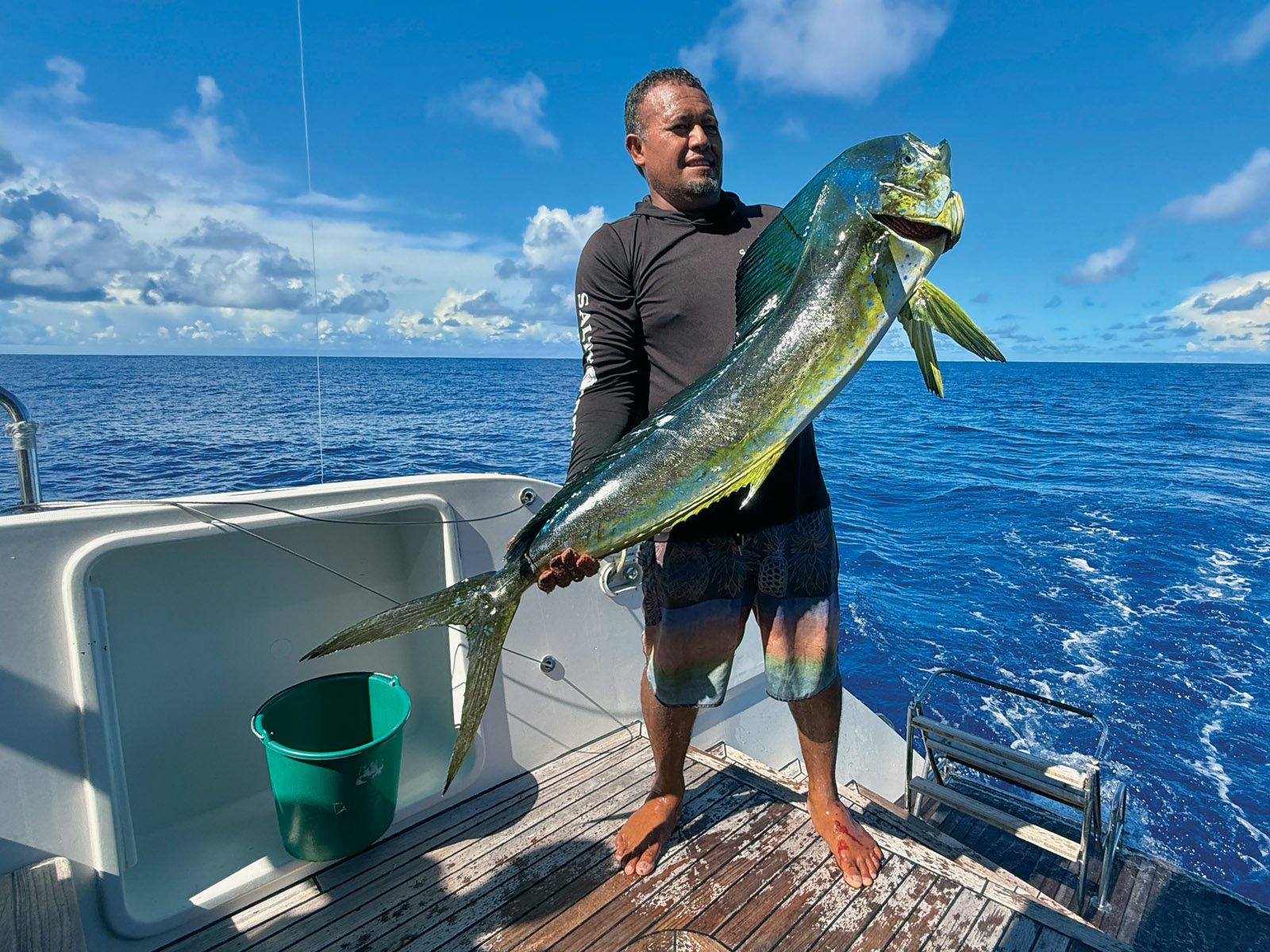
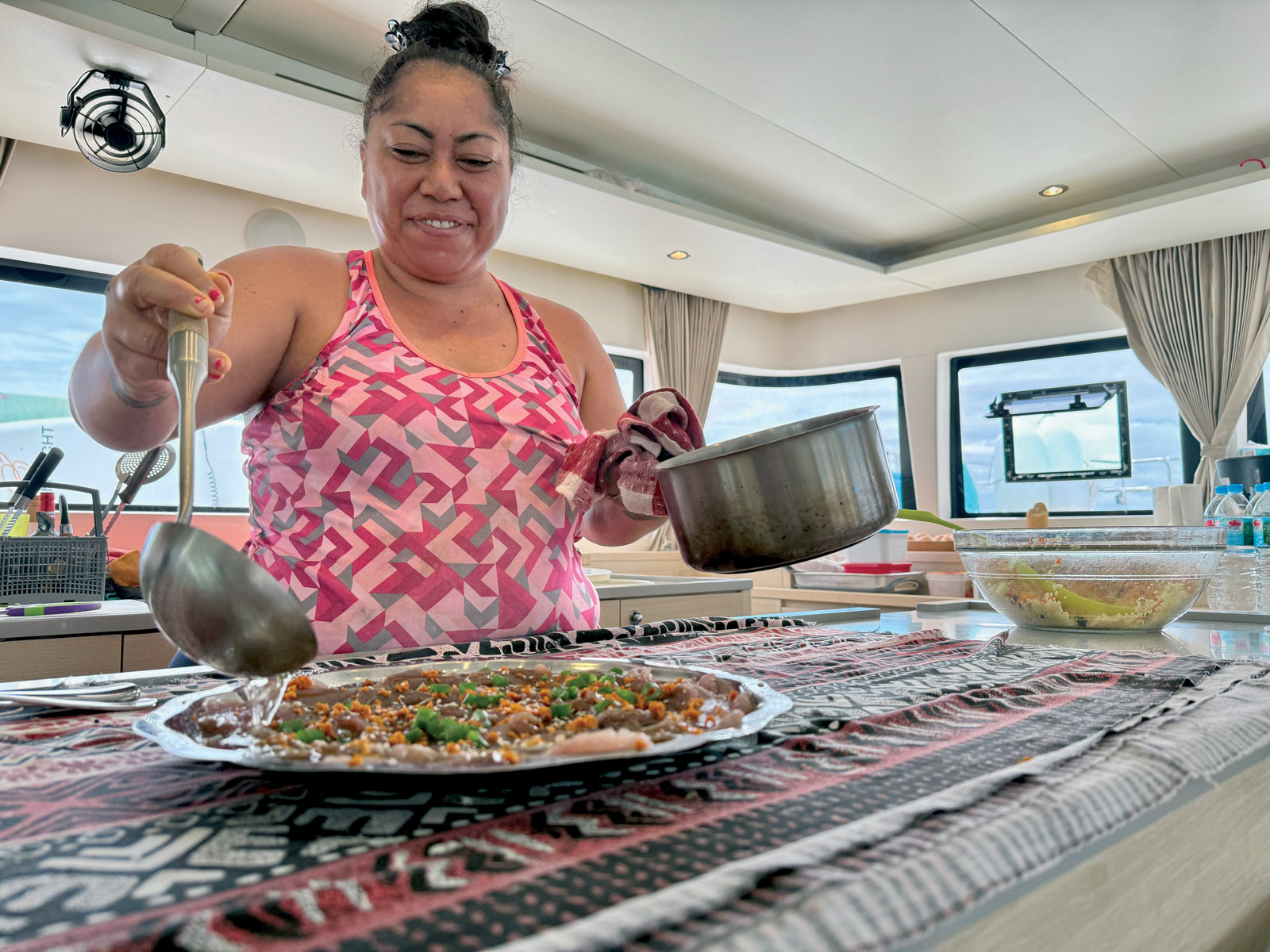
Wen cast his lures into the water and, to our applause, soon reeled in a huge mahi mahi, which Vaea served us the next evening with a homemade vanilla sauce. I’d already gained a couple of pounds since I joining the boat, as she was spoiling us with great food, showcasing the traditional cuisine she has mastered to perfection, but also delicious French dishes to suit all tastes. The portions were enormous, and the tables were always beautifully set, confirming the Polynesians’ innate sense of beauty.
Huahine: A Turquoise Lagoon, Coconut Trees, and Faré
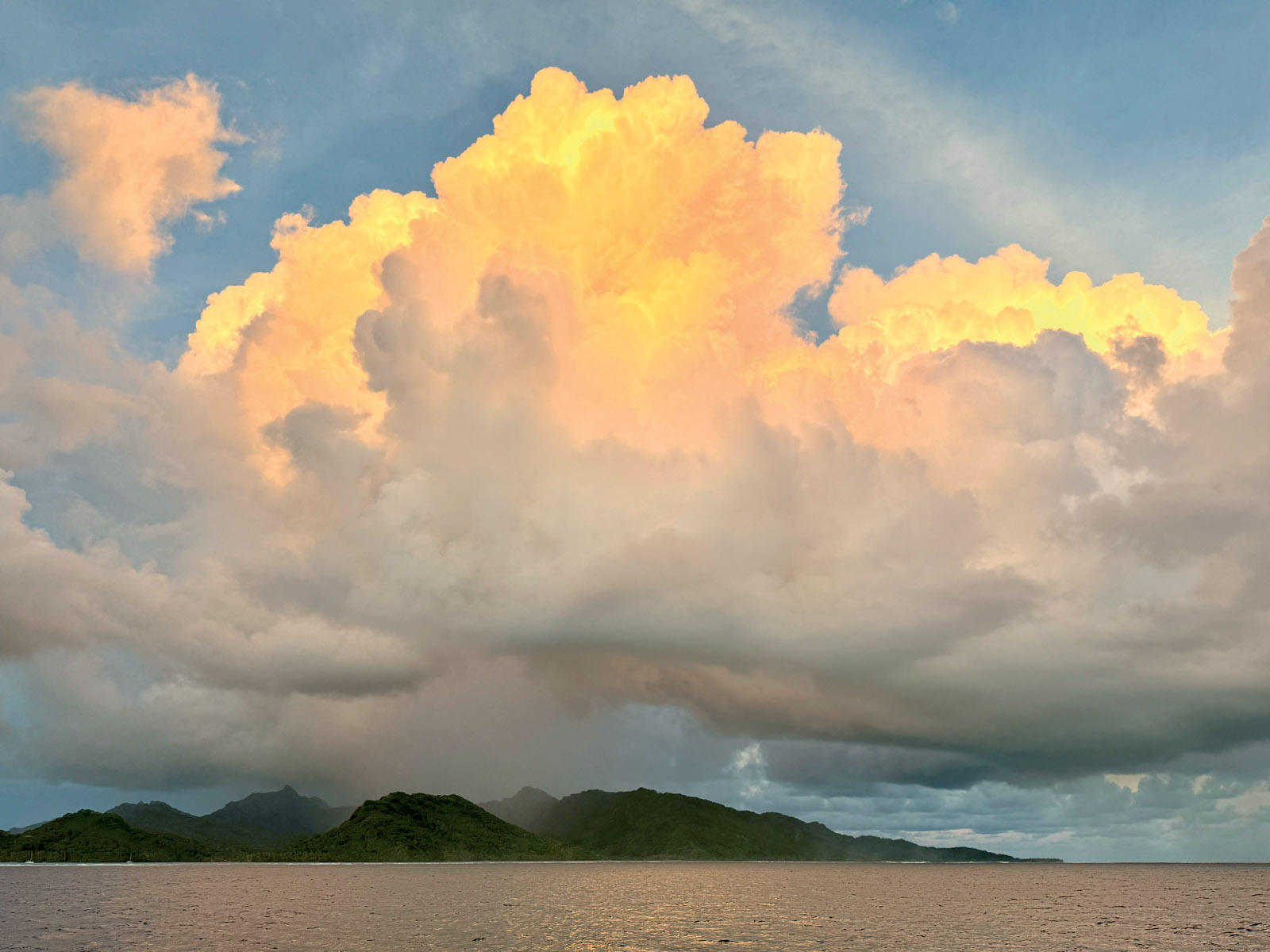
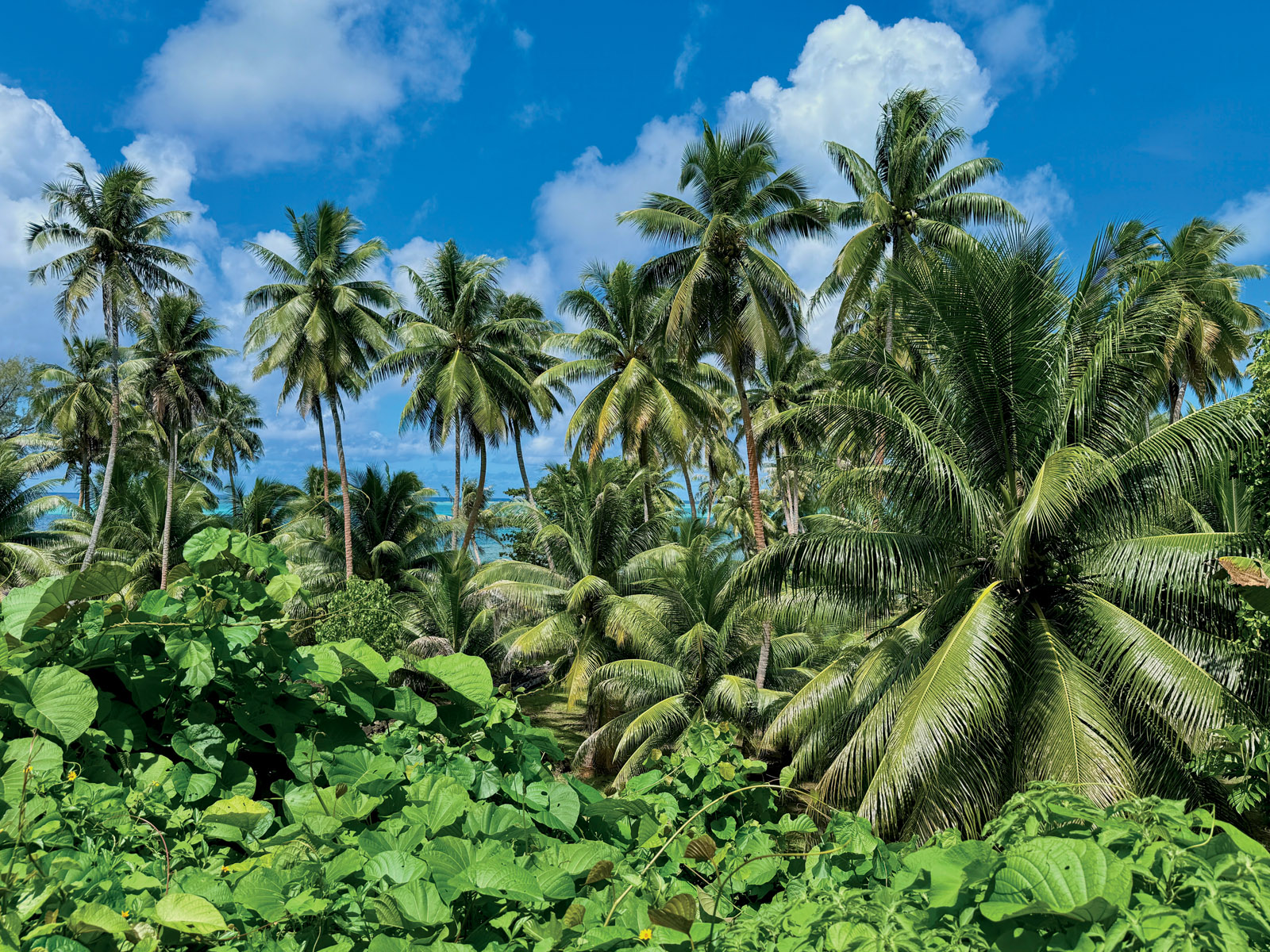
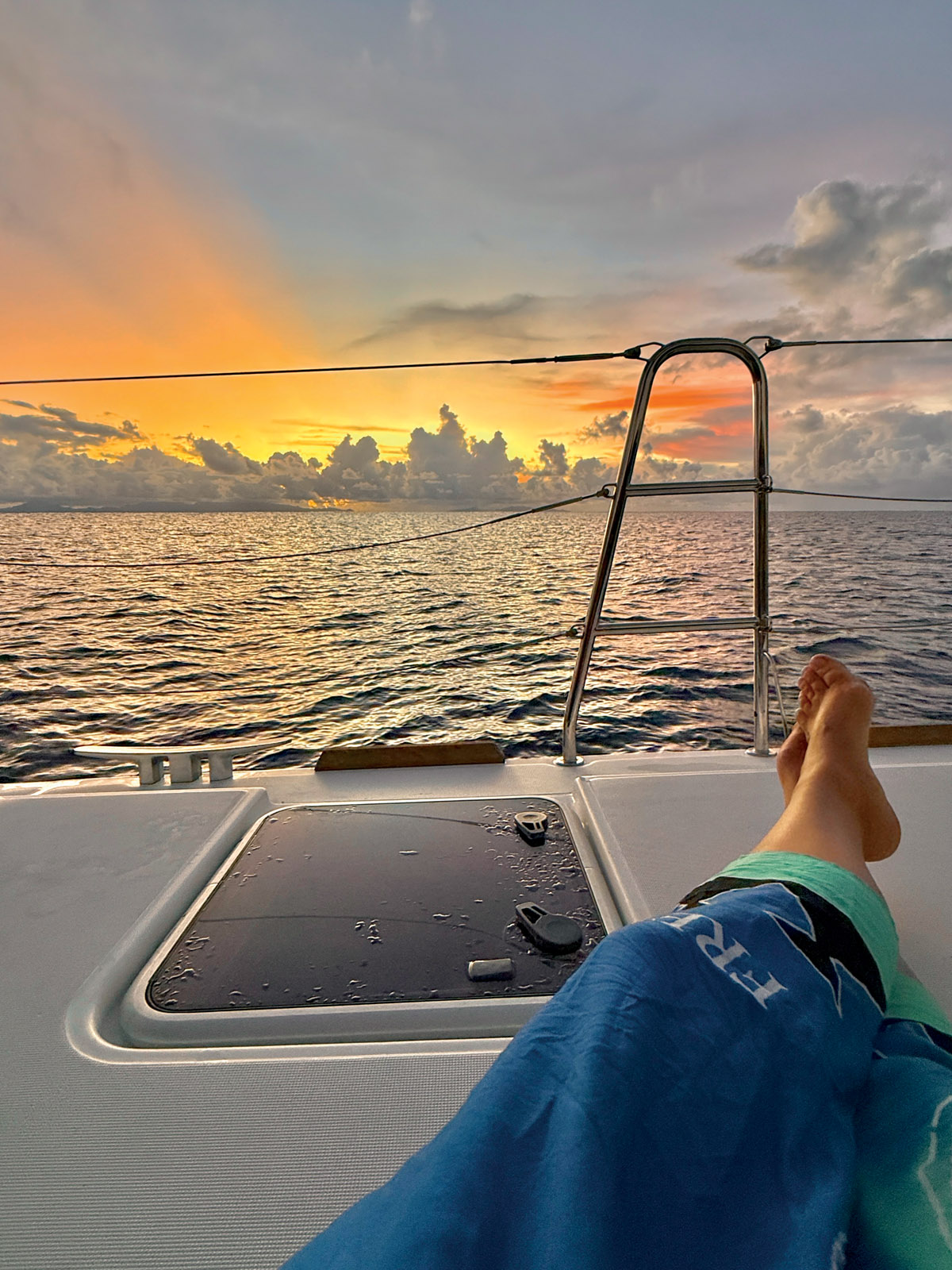
Arriving in the dark, we slept at anchor off Fare, and the next day we went on an excursion for the morning. Huahine has everything to excite the imagination: a turquoise lagoon fringed with coconut trees, faré (traditional thatched houses) rising up among breadfruit and soursop trees, vanilla plantations, pearl farms, stone fish traps governed by centuries-old community rules, hundreds of marae (ancient places of worship and sacrifice), and even sacred eels that the locals come to feed by hand. Formed from the remains of a volcano cut in two by an inlet, Huahine Nui (the large island) and Huahine Iti (the small island) share the same lagoon dotted with motu (small islets). A narrow stretch of water separates the two, but they’re connected by a small bridge. Agricultural and unspoiled, it is still very attached to a traditional lifestyle. Our guide dropped us off on Avea Beach where Wen was waiting for us: the wow factor was guaranteed at this anchorage of unreal beauty where all shades of blue blend together, and which I immediately ranked among the most beautiful I have ever seen. Being so high above the water really allows you to appreciate its splendor... but we were in for more surprises. We headed to Hana Iti Bay for a memorable snorkeling experience in a mesmerizing setting off the beaten track. To round off this perfect day, the sun set in a pearl-gray palette turning to orange-pink, then purple. With my senses heightened, I drifted off to sleep wondering how I was ever going to leave this paradise just a week later...
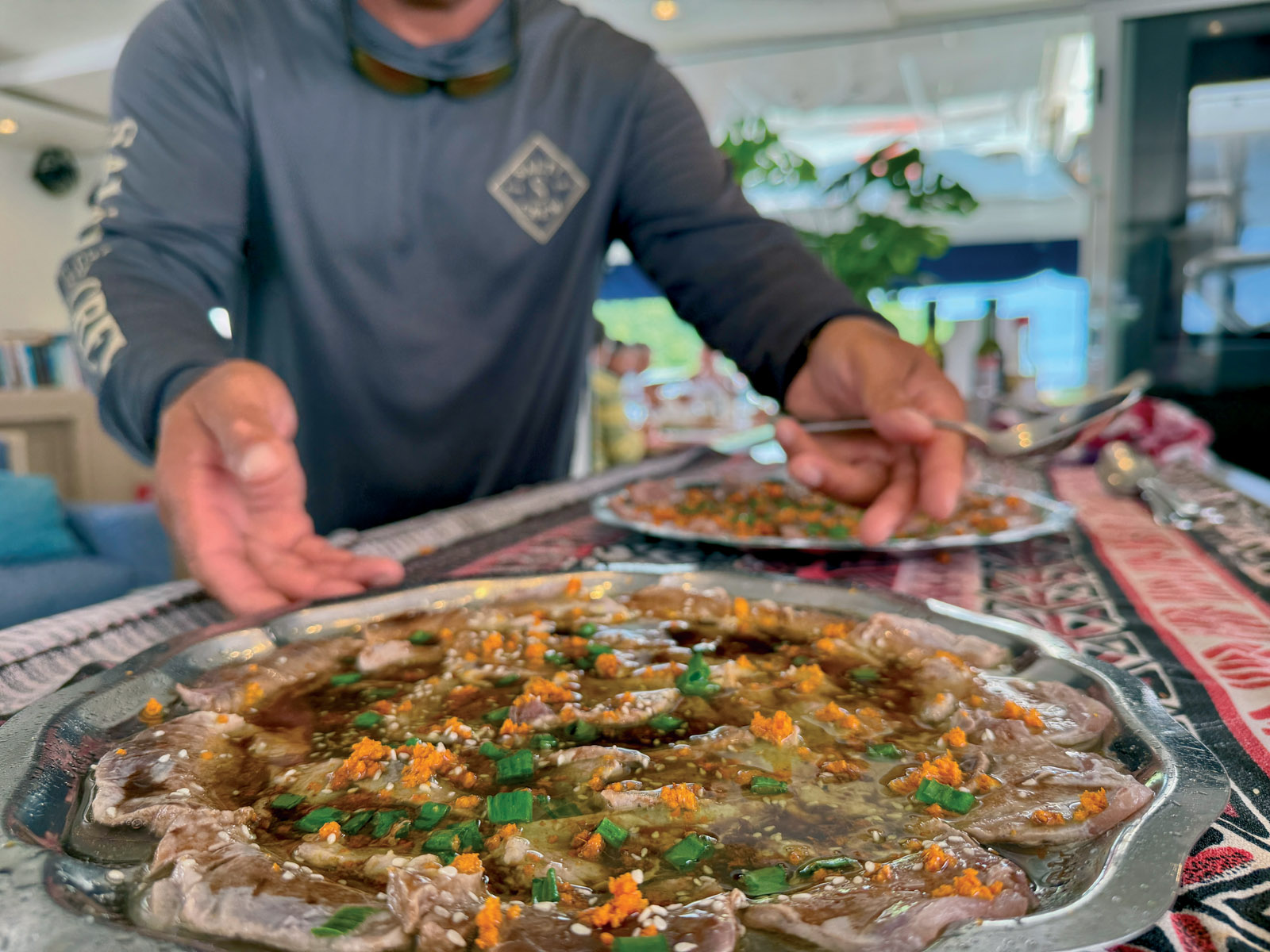
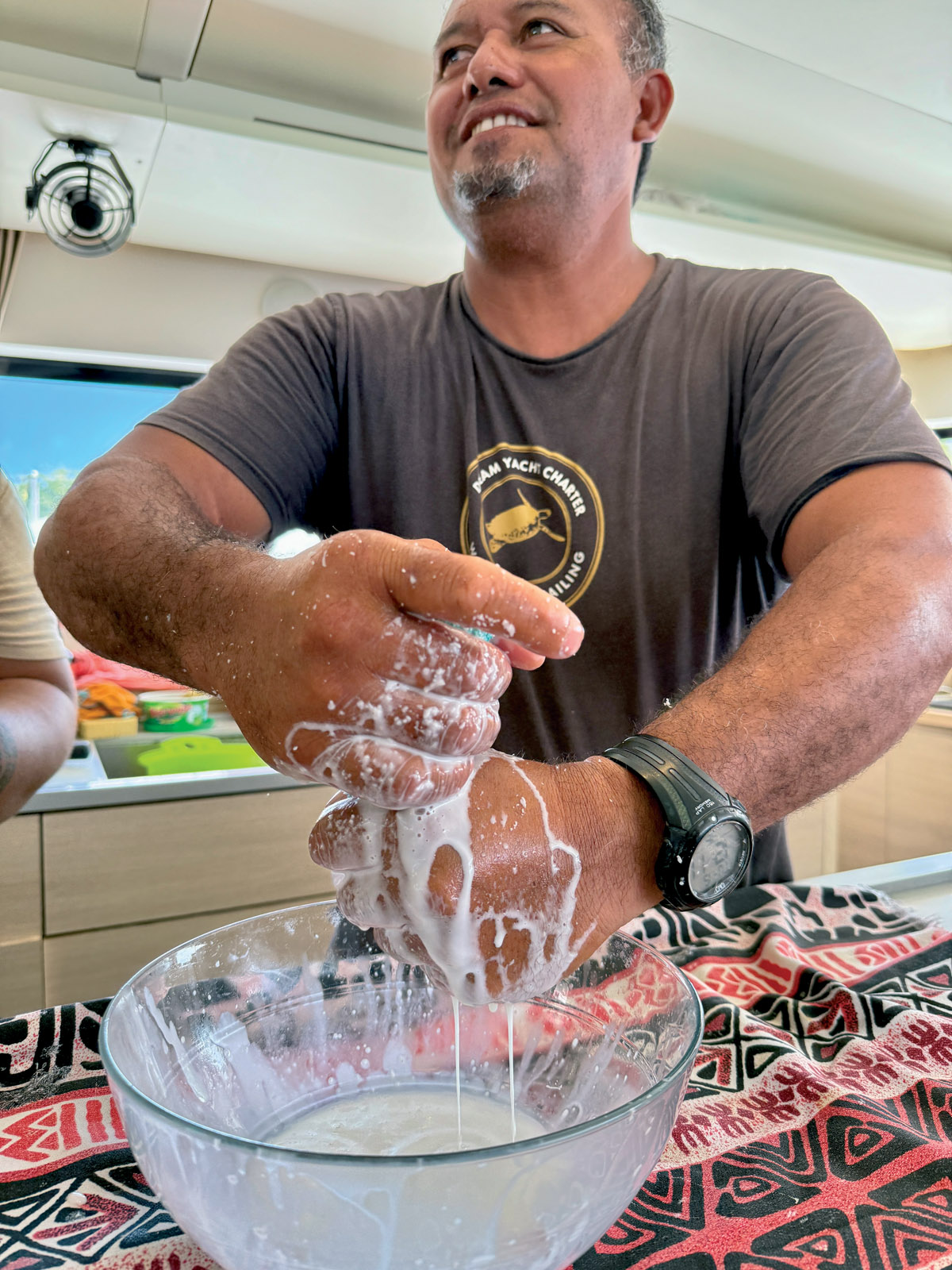
We were some 30 miles from Taha’a, a beautiful, peaceful and discreet island where Vaea is from. “Welcome to my home!” she said with a big smile, pointing to its indented coastline. It shares the same sparkling lagoon as Raiatea, just 20 miles distant, where the Dream Yacht base is located, but remains off the beaten tourist track. We were to visit that island later - for now, Wen wanted to treat us to an exceptional anchorage he knows well, where the water is crystal clear and the snorkeling is exceptional: a rich marine fauna frolics in a labyrinth of corals while docile blacktip reef sharks swim around the catamaran by the dozen, as usual. In the evening, Vaea prepared raw tuna with coconut milk. Wen poured the fresh coconut milk in front of us after chopping open the nut. Life is good, quite simply!
Raiatea, the Sacred Island
The next morning, big black clouds gathered over the peaks of Raiatea as we headed for Uturoa, the island’s adminis- trative capital, accompanied by dolphins and va’a, the outrigger canoes that Polynesians vigorously propel across the sapphire waters of the Pacific with their paddles. We spent the morning strolling among the stores of this small town of 2,500 inhabitants, chatting easily with the shopkeepers who explained to us that here, people still live like in the good old days, without pretension. As soon as we left the main street, we were plunged into a flamboyant natural environment dotted with dark basalt peaks. As at every stopover, I am fascinated by the lush vegetation of these islands, which, from cordyline to hibiscus, seems to bring together all the tropical species on the planet. Although the sun was playing hide-and-seek that day, this only reinforced the atmosphere of Raiatea, “the sacred island,” and largest of the Leeward Islands. At the heart of Polynesian culture, it was the starting point for all the epic migrations to the other Pacific islands. Visiting the marae of Taputapuatea forces the imagination to plunge into ancient times, before Magellan. This open-air temple, with its basalt paving and coral walls, looks out over the Te Ava Mo’a pass where the first Polynesians made landfall around a thousand years ago.
Bora Bora, the Pearl of the Pacific
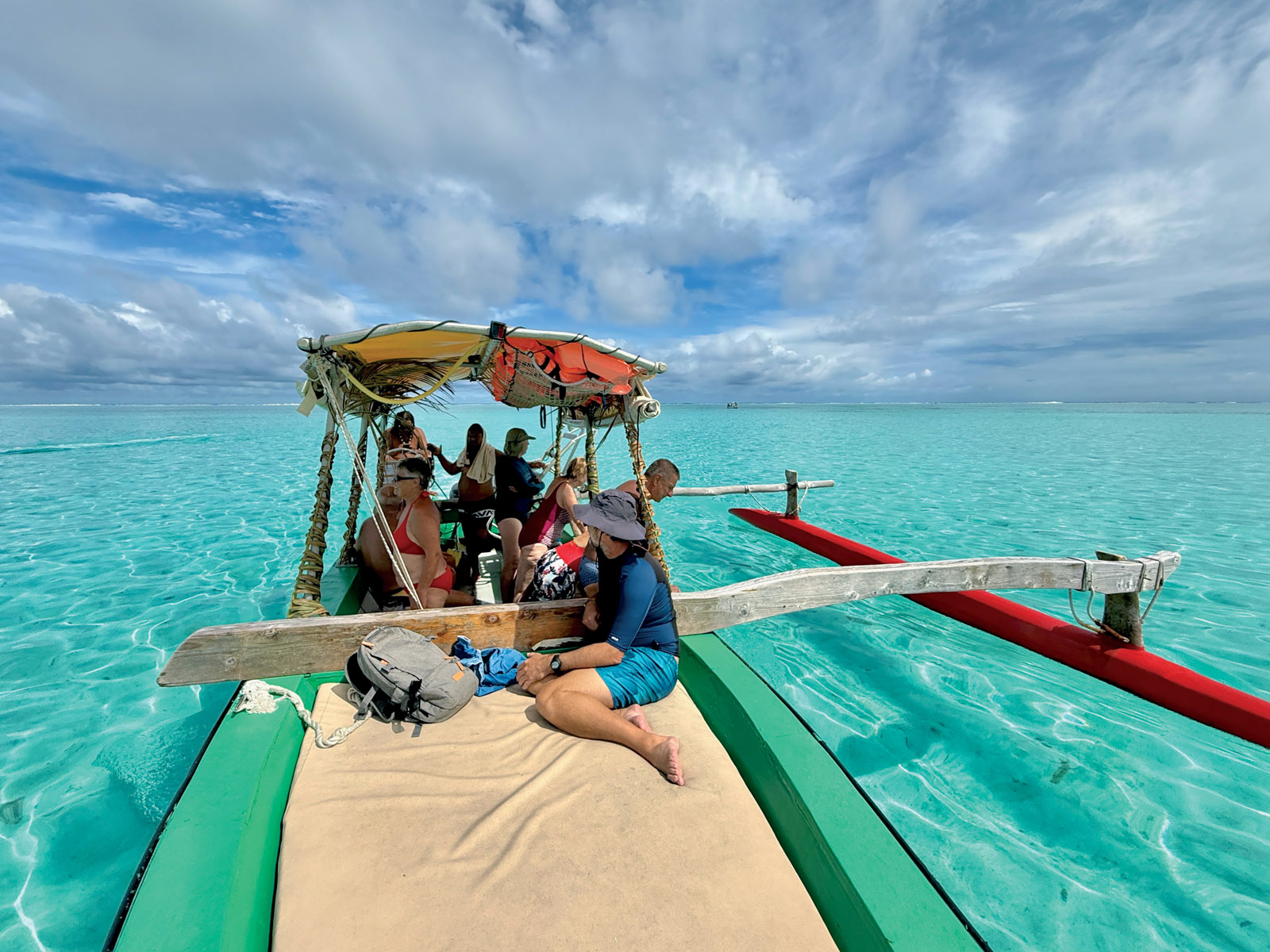
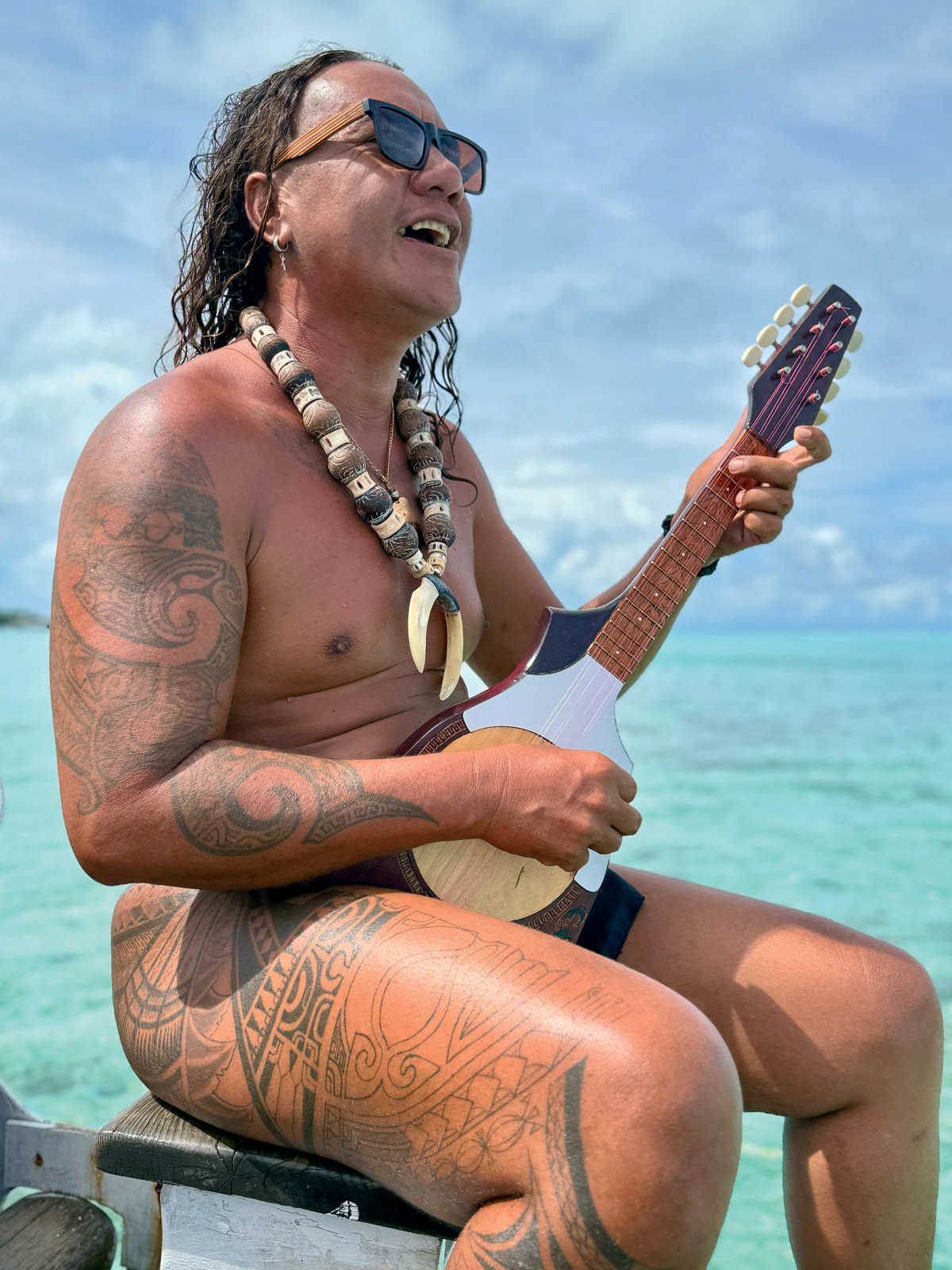
During the night, no rolling disturbed our sleep, as the Lagoon 620 kept completely still despite the storm overhead. We weighed anchor as it was getting light. Intoxicated by the wind, sitting on the port pulpit, I felt as if I was floating above the azure and silver sea from which flying fish leap. The swell had grown a little, reaching six feet (2 meters): rain was expected shortly. It wasn’t time for the mara’amu to set in yet, just a tropical wave typical of the shoulder-- season. I fully savored the scent of happiness on the 25 miles of this passage, with a feeling of touching infinity. The other passengers were enjoying themselves just as much, lying on the flybridge sun loungers, reading or chatting. Eventually, the coral reef drew a line of white spray that rolled along to our starboard side, while in the background was the colossal collapsed volcano that is Bora Bora. Nicknamed “the pearl of the Pacific,” this high and rugged island, bordered by beaches, is surrounded by a 78 km2 (30-square mile) turquoise lagoon whose color variations border on perfection. After crossing the pass, we anchored off front of Taurere Point, covered with pandanus (in the past, the leaves were woven to make sails), which Wen took us to explore on foot and later, we enjoyed a fabulous sunset that painted the sea bronze and mauve. The next day, he entrusted us for the day to a colorful local guide, covered in Polynesian tattoos from head to toe, who took us on his outrigger canoe to swim with blacktip reef sharks, stingrays, and, to our delight, three manta rays that treated us to a most graceful ballet. He regularly entertained us with languid ukulele tunes and tasty slices of pineapple. We returned to the Lagoon with stars in our eyes and had no envy for the guests staying in the luxury hotels’ over-water bungalows at all: no superlative could translate the magical hours we had just experienced.
Vanilla from Taha’a
After a fabulous snorkeling session at Motu Toopua, we begin our return voyage to Taha’a. twenty-four miles later, the wild scent of this island, known for its high-quality vanilla, enveloped us as soon as we arrived at the anchorage in off Motu Tautau. Snorkeling in its superb coral garden is just the prelude to an exciting visit to this graceful land, which is circled by a road revealing small houses hidden in deep bays, a church with a pink roof sitting at the water’s edge, and small pontoons that seem to have been there since the dawn of time. On this unspoiled island, life is as smooth as skin oiled with monoi. Taha’a lives to the rhythm of harvesting, fishing, and pearl farming. It is a conveyor of history that immediately won us over. One last anchorage at Motu Ceran where we were supposed to have a picnic, but the weather forced us to change our plans and we remain aboard, lost in contemplation of the sea crowned by a sky as black as a local pearl, which seemed, by contrast, to be an almost fluorescent emerald green: it was simply sublime. We spent our final evening ashore, in a picturesque restaurant in Fa’a’aha, under torrential rain. It didn’t matter, the Polynesian dance show we watched by torchlight, the famous Ori Tahiti that so shocked the puritanical missionaries, transfixed us with an almost childlike joy. A vahine, with a tiare flower behind her ear, played the ukulele accompanied by percussionists wearing crowns of foliage on their foreheads. An athletic dancer revived the spirit of the warriors of yesteryear by twirling flaming machetes at lightning speed. Magical!
Leaving Wen and Vaea on the morning of the last day, on the quay at Raiatea, was not without emotion: together, they embody everything I’d come to find on this cruise: a warm welcome to visitors to the fenua (“country” in Tahitian), their native land, but also the discovery of unforgettable anchorages and stopovers, living traditions, a way of life close to nature, and above all, a visceral feeling of joie de vivre. Thanks to their professionalism, their absolute availability, their good humor, and the flawless organization of a sailing program that was followed to the letter, we felt right at home aboard their comfy Lagoon 620. Every day, from 5 a.m. to 10 p.m., they went out of their way to make our cruise a dream come true. We were delighted guests, with the added certainty of having made the most of the 430 miles of coastal sailing in the Antipodes. There’s no doubt about it: to discover French Polynesia, you have to head out to sea. Because from island to island, almost without realizing it, you accumulate the most beautiful of treasures: the art of living... in society.